What if the most effective prescription for 2026 isn’t a new pharmaceutical, but a complete redesign of how we view our collective well-being? Most of us feel like a data point in a giant healthcare machine, especially when the CDC reports that 60% of adults now live with at least one chronic condition. You’re likely tired of the noise and the sense of powerlessness that comes with watching community health trends decline despite trillions spent on reactive care. Embracing a holistic approach to public health means we finally stop chasing symptoms and start healing the root causes that affect us all.
This article will show you how to reclaim your agency and use a root-cause perspective to transform both your personal vitality and the wellness of those around you. It’s time to move past the clinical coldness of traditional models and step into a partnership with your own body. We’ll break down the scientific framework for total health and give you the tools to lead a wellness revolution in your own community starting today. You aren’t just a number; you’re a vital part of a larger, living system that deserves to thrive.
Key Takeaways
- Learn how a holistic approach to public health treats the entire community as a living organism, moving beyond simple symptom suppression to address the true origins of wellness.
- Discover the “Whole You” framework and the five interdependent pillars that create a sustainable foundation for population-wide vitality.
- Uncover the truth behind common misconceptions, including the science-backed reality of holistic care and how it is becoming accessible to all communities.
- Gain practical insights on starting your own journey of self-mastery to effectively advocate for root-cause thinking within your local schools and workplaces.
- Explore how Dr. Erica Steele’s micro-model in Virginia Beach serves as a powerful, scalable blueprint for transforming the future of global public health.
What is a Holistic Approach to Public Health?
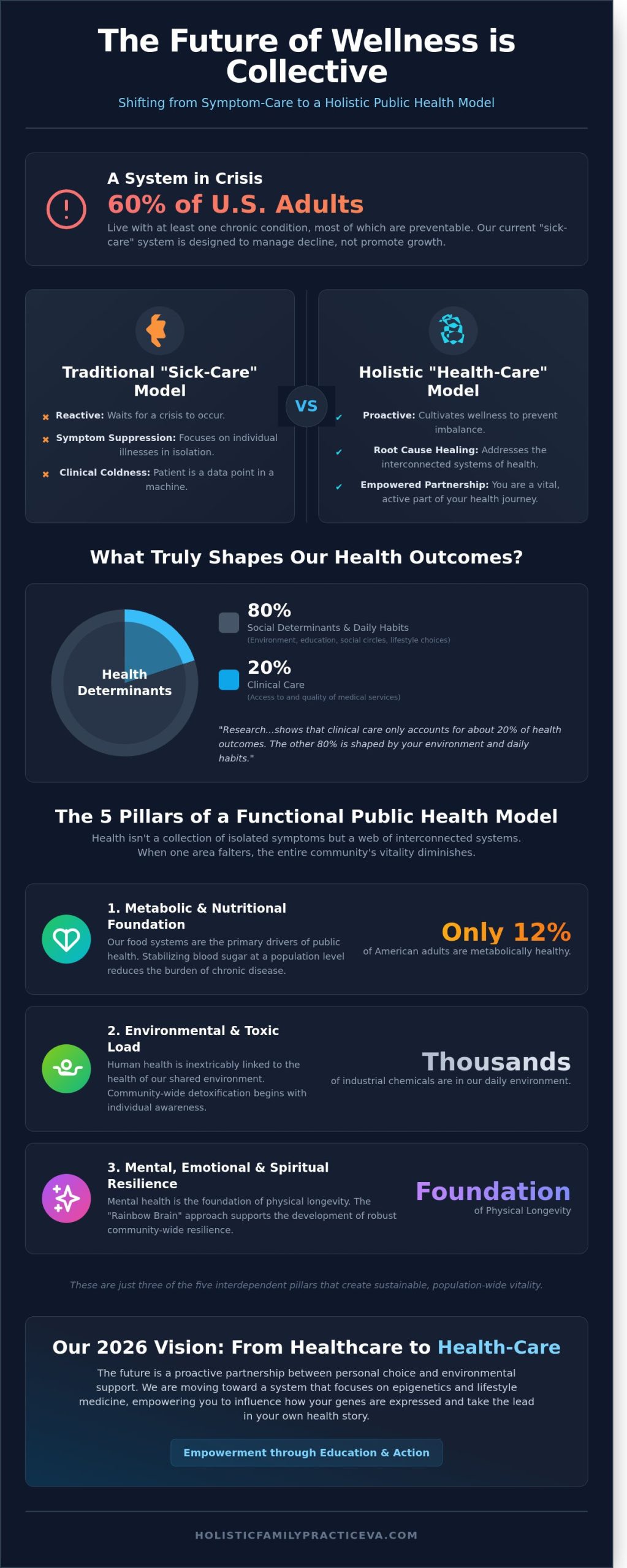
A holistic approach to public health treats our entire community as a single, breathing organism. Instead of focusing on individual illnesses in isolation, we look at the interconnected systems that sustain us. Traditional medicine often relies on a symptom-suppression model; it’s a reactive cycle where we wait for a crisis to occur before intervening. In contrast, the root-cause model seeks to understand why the imbalance began in the first place. We’re moving away from reactive crisis management toward proactive wellness cultivation.
Consider the data: the CDC reported in 2023 that 60% of adults in the US live with at least one chronic disease. Most of these conditions are preventable through lifestyle shifts. By focusing on overall health, we integrate physical vitality, mental clarity, and social connection into one unified journey. This isn’t just about the absence of disease; it’s about the presence of vibrant life. It’s an invitation to stop just surviving and start thriving within a supportive network.
Beyond Biology: The Social Determinants of Health
Your health isn’t just determined by your DNA. Social Determinants of Health (SDOH) are the non-medical factors that influence your well-being. These include the air you breathe, the quality of your local schools, and the strength of your social circles. Research from the University of Wisconsin Population Health Institute shows that clinical care only accounts for about 20% of health outcomes. The other 80% is shaped by your environment and daily habits. You can’t isolate a person’s biology from the context of their community.
The 2026 Vision: From Healthcare to Health-Care
The current system is largely a “sick-care” system designed to manage decline rather than promote growth. As we look toward 2026, the focus is shifting toward epigenetics and lifestyle medicine. We now know that your daily choices can actually influence how your genes are expressed. This evolution empowers you to take the lead in your own story. A holistic approach to public health is the intersection of personal choice and environmental support.
The 5 Pillars of a Functional Public Health Model
Implementing a holistic approach to public health requires us to look at the community as a single organism. We apply the “Whole You” framework to entire populations, recognizing that health isn’t a collection of isolated symptoms but a web of interconnected systems. These five pillars don’t exist in silos; they’re interdependent. When one area falters, the entire community’s vitality diminishes. We use functional medicine as a diagnostic lens to identify these community-wide imbalances before they become chronic crises.
Education serves as the heartbeat of this model. It’s the tool that empowers you to transition from a passive recipient of care to an active participant in your wellness. By providing clear, actionable data, we help communities “Know Their Numbers” and understand the “why” behind their health plans. This shift in perspective turns health into a shared journey rather than a clinical destination. You’re invited to start understanding your body better through our community-focused resources.
Metabolic and Nutritional Foundation
Our food systems are the primary drivers of public health outcomes. According to a 2019 study from the University of North Carolina at Chapel Hill, only 12 percent of American adults are considered metabolically healthy. This isn’t just an individual struggle; it’s a systemic failure. Stabilizing blood sugar at a population level reduces the burden of chronic diseases like Type 2 diabetes, which currently sees 1.4 million new diagnoses every year in the U.S. We bridge this gap by teaching “Functional Medicine Lab Panel Mastery,” helping residents interpret their biomarkers to make informed, wholesome dietary choices.
Environmental and Toxic Load
Modern illness is often a reflection of our surroundings. The EPA reported in 2023 that thousands of industrial chemicals are present in our daily environments, contributing to a rising toxic load. A holistic approach to public health must address these external triggers. We utilize the “One Health” concept, which recognizes that human health is inextricably linked to the health of animals and our shared environment. Community-wide detoxification begins with individual awareness of water quality, air purity, and household toxins, creating a ground-up demand for a cleaner planet.
Mental, Emotional, and Spiritual Resilience
Mental health is the foundation of physical longevity. We use the “Rainbow Brain” approach to support the diverse neurological and emotional needs of the community. Stress is a physiological toxin; the American Psychological Association found in 2023 that 27 percent of adults report being so stressed they can’t function. Healing requires more than just therapy; it requires purpose and connection.
- Purpose: Identifying a reason to get up each morning increases life expectancy.
- Connection: Social isolation increases the risk of premature death by 26 percent.
- Resilience: Holistic healing addresses trauma at the root to prevent physical manifestations of distress.
Myth vs. Reality: Addressing Objections to Holistic Systems
Skepticism is a healthy part of any health journey. You might feel hesitant when shifting away from a purely reactive medical model. The most common objection suggests that a holistic approach to public health lacks scientific rigor. This couldn’t be further from the truth. We’re here to bridge that gap with evidence and empathy, helping you understand how integrative systems actually work to protect your future.
Is Holistic Public Health Scientific?
Modern holistic care isn’t based on guesswork; it’s rooted in biochemistry and peer-reviewed data. A 2019 study published in JAMA Network Open found that functional medicine models significantly improved patient-reported health-related quality of life over six months compared to traditional primary care. We encourage you to “Know Your Numbers” through comprehensive labs that look at inflammatory markers like C-Reactive Protein. This data allows us to identify root causes before they become diagnoses. It’s about using hard science to support your body’s natural design and intuitive wisdom.
The ‘Too Expensive’ Fallacy
Many people assume wellness is a luxury for the wealthy. Let’s look at the math. The American Diabetes Association reports that the average cost of diagnosed diabetes is $16,752 per year. In contrast, a comprehensive holistic program or a series of online wellness courses costs a small fraction of that annually. Investing in prevention now saves thousands in future hospitalizations and prescriptions. You aren’t just spending money; you’re reallocating it to avoid a lifetime of medical debt.
Virtual services have also leveled the playing field for everyone. You can now access expert guidance from your living room, making high-quality care accessible to the 85% of households with internet access. Community-led initiatives further reduce the tax burden by lowering the 90% of US healthcare costs currently spent on chronic and mental health conditions. By choosing a holistic approach to public health, we create a sustainable system that empowers the individual while protecting the community’s resources.
- Prevention: Costs $500 to $2,000 annually for wellness coaching and supplements.
- Chronic Management: Costs $10,000+ annually for medications, specialist visits, and lost productivity.
- Accessibility: Online portals and group webinars reduce individual costs by 40% compared to traditional in-office visits.
How to Implement a Holistic Mindset in Your Community
Building a healthy community starts with your own self-mastery. You can’t lead or inspire your neighbors if your own internal battery is at 5%. When you prioritize your well-being, you’re practicing a holistic approach to public health by reducing the collective burden on local medical systems. It’s about moving away from reactive care and toward a proactive, root-cause mentality in every local institution.
- Schools: Advocate for nutrition programs that replace processed sugars with wholesome foods. According to the CDC, 1 in 5 children now face obesity-related risks, making root-cause education in cafeterias vital.
- Workplaces: Encourage “Wellness Circles” where colleagues track shared goals like daily step counts or mindfulness minutes. Small groups foster accountability that individual apps often lack.
- Virtual Bridges: Use virtual consultations to ensure rural neighbors have the same access to specialists as those in urban centers. Telehealth usage remained 38 times higher in 2023 than pre-pandemic levels, proving its efficacy in closing geographical health gaps.
Your Personal Health as a Public Service
Start understanding your body better as a civic duty. When you’re vibrant and energized, you have the capacity to volunteer, support your family, and lead local initiatives. Your wellness journey serves as a living blueprint for those around you. Use this total health checklist to begin your mastery today:
- Hydrate with at least 64 ounces of filtered water daily.
- Identify your “root” stressors by journaling for 10 minutes before bed.
- “Know Your Numbers” by scheduling a baseline blood panel to track inflammation.
- Move your body for 30 minutes to boost lymphatic drainage and immune function.
Advocating for Integrative Primary Care
Real change happens when we demand more from our local healthcare systems. Talk to your providers about functional health. Ask them how your gut health might be impacting your mood or why your sleep patterns are disrupted. If your current clinic only treats symptoms with a pill, it’s time to seek integrative medicine doctors near me to find partners who look at the “whole you.”
A holistic approach to public health requires us to reboot our local mind-body connections. By building a network of like-minded practitioners and neighbors, we create a safety net that catches people before they fall into chronic illness. We’re more than happy to explain the what, when, where, and why of your health plan so you can lead this charge.
Holistic Family Practice: A Micro-Model for Macro Change
Dr. Erica Steele founded Holistic Family Practice with a clear, ambitious vision: to transform Virginia Beach into a community where health is proactive rather than reactive. This practice operates as a micro-model for how a holistic approach to public health functions in the real world. By focusing on the individual, Dr. Steele creates a ripple effect that strengthens the entire community’s well-being. The practice serves five major patient groups, including pediatric, adult, geriatric, chronic illness, and wellness seekers. This demographic spread represents a true cross-section of the public, ensuring that every stage of life receives the attention it deserves.
We believe in getting to the root of the problem. Clinical coldness has no place here. Instead, we offer a supportive partnership where your mind, body, and soul are treated as one interconnected system. When you understand the “why” behind your health, you gain the power to change your “what.” This transition from passive treatment to active mastery is what drives sustainable change across Virginia Beach and beyond.
Empowering Your Health Journey in Virginia Beach
Local impact starts with education. Dr. Steele hosts regular webinars and community events designed to demystify complex medical data. We want you to “Know Your Numbers” so you can make informed choices about your daily habits. This empowerment is the heartbeat of our Recode Protocol. In this framework, you aren’t just a name on a chart; you’re an active participant in your own healing. By engaging with our local workshops, you join a growing network of residents committed to a wholesome approach to life. A holistic approach to public health is only as strong as the individuals who participate in it.
Start Your Journey Today
Personal health is the ultimate key to public health. It’s time to stop guessing and start knowing. Your first step is a 15-minute Discovery Call. This initial conversation serves as the gateway to your larger health journey, allowing us to align our strategies with your specific goals. If you prefer to start learning immediately, our online courses provide mastery-level guides on nutrition and metabolic health. We’re more than happy to explain the what, when, where, and why of your wellness plan. Take that first step today. We’re ready to partner with you to create a vibrant, healthy future for yourself and your community.
Lead the Revolution for Your Whole Health
The roadmap for 2026 shows a clear shift away from passive symptom management toward active, root-cause healing. We’ve explored how the 5 pillars of functional health provide a framework to restore metabolic balance and mental clarity. By embracing a holistic approach to public health, we move toward a model that values the whole person rather than just a collection of lab results. Dr. Erica Steele, a board-certified Naturopathic Doctor, leads this charge by providing personalized root-cause analysis that bridges the gap between clinical data and your unique wellness journey.
Whether you’re visiting our Virginia Beach office or utilizing virtual care options available in all 50 states, the tools for transformation are within your reach. You don’t have to navigate complex health challenges alone. It’s time to know your numbers and trust your body’s ability to heal when given the right support. Take the first step toward a more vibrant, empowered future today.
Empower your health journey and book a Discovery Call with Dr. Steele today.
Your journey to a more wholesome life is a partnership we’re honored to join.
Frequently Asked Questions
What is the difference between public health and holistic health?
Public health focuses on the wellness of entire populations, while holistic health centers on an individual’s mind, body, and spirit. Traditional public health often relies on 19th-century sanitation models or mass interventions. A holistic approach to public health combines these large-scale protections with personalized wellness strategies that address the Whole you. This ensures that community-wide safety doesn’t overlook the unique nutritional and emotional needs of the individual.
How can a holistic approach prevent future epidemics?
A holistic approach to public health prevents epidemics by strengthening the collective immune baseline of a community before a pathogen arrives. Data from the 2020 pandemic showed that 94% of individuals with severe outcomes had at least one underlying metabolic condition. By focusing on root-cause wellness and metabolic health, we create a population that is naturally more resilient. This shift from reactive crisis management to proactive health mastery reduces the burden on hospitals.
Is functional medicine considered part of a holistic public health strategy?
Functional medicine is a core pillar of a holistic strategy because it uses advanced testing to help you Know Your Numbers and identify imbalances early. According to the Institute for Functional Medicine, this approach targets the biological systems that drive 80% of chronic illness costs. When public health initiatives include functional screenings for gut health or vitamin D levels, they move away from one-size-fits-all treatments. This empowers individuals to heal from the inside out.
Can holistic public health initiatives save money for families?
Holistic initiatives save families an average of $2,000 annually by reducing reliance on emergency care and long-term pharmaceutical use. A 2022 study by the Lancet found that preventative lifestyle changes could slash global healthcare spending by $1.1 trillion. When you focus on wholesome nutrition and stress management, you avoid the high costs of managing preventable conditions like Type 2 diabetes. Investing in your health journey now prevents the financial drain of future medical crises.
What are the most important social determinants of health to watch for?
The five primary social determinants include economic stability, education access, healthcare quality, neighborhood environment, and social community. Research from the CDC indicates that these non-medical factors influence up to 50% of health outcomes. You should watch for local food deserts or a lack of green spaces in your zip code. Improving these environmental factors allows every member of the community to access the intuitive wellness and vitality they deserve.
How do I find a holistic doctor who understands public health in Virginia Beach?
You can find a practitioner by searching for providers who specialize in integrative family medicine and community wellness. Holistic Family Practice in Virginia Beach offers a partnership that looks at the Whole you while considering local environmental health factors. We encourage you to book a discovery call to see if our educational approach aligns with your goals. Our team focuses on empowering your health journey through both individual care and broader public health education.
Can I participate in holistic public health if I have a chronic disease?
You can absolutely participate because holistic health is about progress and mastery, not just the absence of disease. Over 60% of American adults live with at least one chronic condition, making this inclusive approach more vital than ever. We help you get to the root of the problem to manage your symptoms while improving your overall quality of life. Your journey toward wellness contributes to the collective health and resilience of our entire community.
What role does nutrition play in the public health of a community?
Nutrition is the foundation of public health because it dictates the metabolic health of 100% of the population. The USDA reports that 90% of Americans don’t meet the daily vegetable intake recommendations, leading to widespread systemic inflammation. Community-based nutrition programs that provide access to wholesome, organic foods can reverse these trends. By prioritizing intuitive eating and nutrient density, we empower every neighbor to take an active role in their own healing and vitality.