What if the difference between answering your soul-calling and making a $30,000 educational mistake is simply understanding the “accreditation gap”? You know you’re meant to guide others toward wellness, yet the 2,500+ wellness programs available online make it hard to distinguish a legitimate clinical path from a basic health coaching certificate. Finding the right schooling for holistic health practitioner can feel overwhelming when you’re facing 50 different sets of state licensing laws and unaccredited programs that won’t give you the clinical authority you crave.
It’s frustrating to feel stuck at the starting line because you’re worried about wasting your time. You deserve a clear, honest roadmap that honors your intuition while respecting the rigorous science of the human body. This guide provides exactly that. You’ll discover the specific educational requirements, certification paths, and clinical training hours required to become a high-impact practitioner. We’ll explore the 4 distinct levels of professional training, from holistic nutrition certifications to doctoral degrees, so you can choose the path that aligns perfectly with your vision for the future.
Key Takeaways
- Understand the evolving landscape of holistic health and how to align your professional path with the core philosophy of treating the whole person-mind, body, and soul.
- Navigate the three essential tiers of schooling for holistic health practitioner success, from foundational wellness coaching to specialized clinical training in nutrition and herbalism.
- Identify the scientific non-negotiables, such as functional lab analysis and biochemistry, that empower you to look past standard ranges toward true optimal health.
- Gain clarity on the accreditation process and board exam preparation to ensure your credentials meet the highest professional and legal standards.
- Learn how to bridge the gap between classroom theory and soul-centered patient care through strategic mentorship and real-world clinical application.
Understanding the Holistic Health Practitioner Landscape
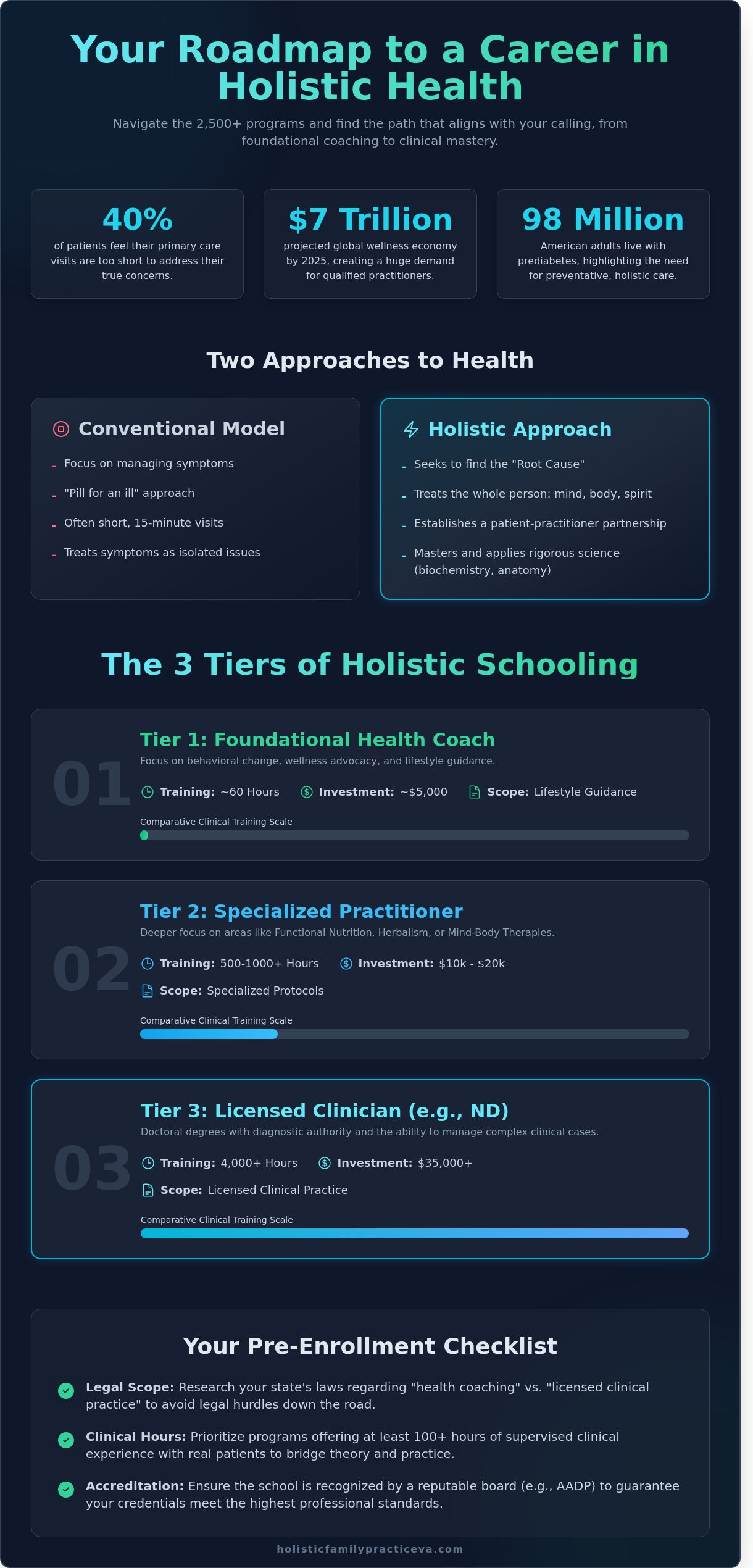
By 2026, the role of a Holistic Health Practitioner (HHP) has evolved into a sophisticated blend of ancestral wisdom and rigorous scientific application. You aren’t just looking at a lab report; you’re looking at a human being with a story, a history, and a unique cellular makeup. This shift is driven by a stark reality. Recent data from 2024 shows that 40% of patients felt their primary care visits were too short to address their actual concerns. People are tired of the 15 minute “pill for an ill” model. They want a partnership, and they want to be seen as a whole person rather than a collection of symptoms.
The core philosophy of this work is rooted in Holism, which posits that the mind, body, and spirit are inextricably linked. If one area suffers, the entire system feels the impact. When you begin your journey toward becoming a practitioner, you’re learning to see these invisible threads. However, the surge in demand has created a crowded market. It’s vital to distinguish between a weekend certificate holder and a licensed clinician. A licensed Naturopathic Doctor (ND) undergoes 4,000 hours of clinical training, while a wellness coach might complete a 60 hour program. Both have value, but their scope of practice is vastly different. Choosing the right schooling for holistic health practitioner goals starts with knowing which level of care you feel called to provide.
Holistic vs. Conventional Medical Education
Reputable holistic schooling doesn’t ignore modern science; it masters it. You’ll study biochemistry, pathology, and anatomy just like a conventional student. The difference lies in the application. While a conventional program might focus on managing symptoms with pharmaceuticals, your training will focus on “Root Cause” analysis. For example, instead of just seeing a skin rash, you’ll learn to investigate the gut microbiome and stress hormones. High quality programs require at least 200 hours of foundational sciences to ensure you’re practicing safely and effectively. This ensures you can speak the language of conventional doctors while offering a more restorative approach.
Identifying Your Niche in the Wellness Economy
The wellness economy is projected to reach $7 trillion globally by 2025. To thrive, you must specialize. Functional medicine focuses on metabolic health, which is critical since 98 million American adults currently live with prediabetes. If you’re drawn to mental health, your schooling for holistic health practitioner roles might focus on the gut brain axis and nutritional psychology. Your educational investment should match your desired patient outcomes. A $35,000 degree in naturopathy allows for diagnostic power, while a $5,000 health coaching certification focuses on behavioral change. Both paths are essential for the 2026 healthcare landscape, but they require different levels of commitment and financial planning.
As you explore your options, keep these three factors in mind:
- Legal Scope: Research your state’s laws regarding “health coaching” versus “licensed clinical practice” to avoid legal hurdles.
- Clinical Hours: Look for programs that offer at least 100 hours of supervised clinical experience with real patients.
- Accreditation: Ensure the school is recognized by a board like the American Association of Drugless Practitioners (AADP) or similar governing bodies.
Empowering yourself with the right education is the first step in helping others find their path to wellness. The world needs practitioners who are ready to listen, learn, and lead with compassion. By choosing a program that balances science with soul, you’re setting the foundation for a career that truly changes lives.
The 3 Tiers of Schooling for Holistic Health Practitioners
Choosing your path in the healing arts starts with a clear understanding of your “Scope of Practice.” This legal and professional boundary determines whether you’ll provide lifestyle guidance or manage complex clinical cases. Finding the right schooling for holistic health practitioner depends entirely on how you want to serve your community. Education isn’t just about a certificate; it’s about gaining the mastery needed to guide others toward their own wholesome wellness journey. You’re not just learning facts; you’re learning how to support the mind, body, and soul of every person you encounter.
Tier 1: Health Coaching and Foundational Certificates
Tier 1 programs focus on behavioral change and wellness advocacy. Schools like the Institute for Integrative Nutrition (IIN) or the Health Coaching Institute (HCI) offer programs that typically last between 6 months and 1 year. These certifications empower you to help clients set goals, improve their daily hydration, and choose nutrient-dense foods. You’ll act as a supportive partner, helping clients implement the “what” and “how” of a healthy lifestyle. It’s important to remember that at this level, you won’t have the legal standing to diagnose conditions or prescribe specific protocols. You’re a guide who bridges the gap between a doctor’s office and a client’s daily reality.
Tier 2: Professional Clinical Certifications
If you want to dive deeper into the “why” of a health struggle, Tier 2 is your destination. This level includes the Certified Nutrition Specialist (CNS) and Board Certified in Holistic Nutrition (BCHN) designations. The CNS requires a Master’s degree in a related field and 1,000 hours of supervised practice. The BCHN, which is accredited by the National Association of Nutrition Professionals (NANP), requires 500 contact hours after your initial studies. Formal credentialing for healthcare professionals at this level ensures you can safely use therapeutic diets and targeted supplements to address the root of a problem. Many practitioners with existing medical backgrounds, like Registered Nurses or Dietitians, use these programs as a bridge to transition into a more intuitive, holistic model of care.
Tier 3: The Path to Becoming a Holistic Doctor
The most intensive schooling for holistic health practitioner involves doctoral-level training. This includes 4-year residential programs at colleges accredited by the Council on Naturopathic Medical Education (CNME). Naturopathic Doctors (NDs) complete over 4,100 hours of training in both conventional and natural medicine, including clinical rotations. Another advanced option is the Doctor of Clinical Nutrition (DCN), which focuses heavily on functional medicine and biochemical individuality. These clinicians are trained to manage complex chronic diseases, such as autoimmune conditions or metabolic syndrome, using advanced lab analysis. This level of education provides the authority to lead a patient’s entire medical team and interpret the “numbers” of their health data with precision. If you’re ready to start your own transformation before helping others, you can start understanding your body better through a personalized wellness assessment.
Core Curriculum: What You Must Learn to Be Effective
To become a powerful healer, you need a foundation built on rock-solid science and deep empathy. Effective schooling for holistic health practitioner programs don’t skip the hard sciences; they use them as a springboard for deeper understanding. You’ll dive into the mechanics of the 37 trillion cells that make up the human body. This isn’t just about memorizing parts. It’s about understanding the “why” behind every biological process. The non-negotiables of your education include:
- Anatomy and Physiology: You must know the roadmap of the body to understand how systems like the endocrine and digestive tracts interact.
- Biochemistry: This is the language of life. You’ll study how a single magnesium deficiency can disrupt over 300 different enzymatic reactions.
- Nutritional Science: You’ll learn that food is information. This involves studying how phytonutrients interact with DNA to turn health markers on or off.
- Psychoneuroimmunology (PNI): This field proves the mind and body aren’t separate. Research indicates that 75% to 90% of all primary care visits are for stress-related issues. You’ll learn how emotional trauma translates into physical inflammation.
Your education should empower you to look at the “Whole you” rather than a collection of symptoms. By mastering these core pillars, you bridge the gap between traditional medical knowledge and wholesome, intuitive wellness. It’s about getting to the root of the problem, whether that root is nutritional, mental, or physical.
Mastering Functional Diagnostics
Conventional labs usually look for disease that’s already present. Your schooling for holistic health practitioner must teach you to look for dysfunction before it becomes a diagnosis. You’ll learn that “normal” ranges are often too broad. For example, while a standard reference range for Vitamin D might start at 30 ng/mL, true immune resilience often requires levels between 60 and 80 ng/mL. To truly help patients, you must “Know Your Numbers.” Integrating the Functional Medicine Lab Panel Mastery course into your learning path allows you to interpret advanced blood chemistry and hormone panels with precision. You’ll move beyond “fine” and guide patients toward “optimal.”
The Art of Clinical Intuition
Data is only half the story. Dr. Erica Steele often emphasizes that 80% of a diagnosis comes from the patient’s history and your ability to listen. Authentic practice must “come from your soul” to be truly effective. This means developing a “healing presence” that conventional schools often overlook. In her practice, Dr. Steele integrates rigorous clinical data with intuitive support, ensuring every patient feels seen and heard. You’re not just treating a lab report; you’re supporting a human being’s journey toward wholeness. This blend of science and soul is what makes a practitioner truly transformative. It’s a partnership where you serve as a wise and nurturing guide, helping others take an active role in their own health journey.
Accreditation, Board Exams, and Legal Considerations
Choosing the right schooling for holistic health practitioner is only half of your professional evolution. You must also ensure your education carries the weight of legal and professional legitimacy. This process protects your dream and the patients you’ll eventually serve. Start by verifying that your institution holds accreditation from recognized bodies like the Council on Naturopathic Medical Education (CNME) or the Distance Education Accrediting Commission (DEAC). Without this stamp of approval, you might find yourself ineligible for federal financial aid or, more importantly, barred from sitting for national board exams.
Once you’ve secured your degree, the next phase involves these critical steps:
- Board Certification: Prepare for exams like the NPLEX for naturopathic doctors or the NANP board exam for holistic nutritionists. These tests prove you’ve mastered the “root of the problem” approach.
- State Licensing: Research the specific requirements in your area. As of 2024, 26 jurisdictions in the U.S., including the District of Columbia and Puerto Rico, offer formal licensure for naturopathic physicians.
- Title Protection: Understand which titles you can legally use. In some states, calling yourself a “Doctor” without a specific license can lead to legal complications.
- Liability Insurance: Secure a professional policy. Even the most compassionate, intuitive practitioners need a safety net to protect their practice assets and personal peace of mind.
This phase of your journey requires patience and attention to detail. It’s the bridge between being a student and becoming a powerful, authentic provider. When you understand the legalities, you’re free to focus on what truly matters: the healing journey of your community. Your schooling for holistic health practitioner provides the knowledge, but these legal steps provide the platform to practice safely.
Navigating the Legal Landscape in the US
The legalities of holistic medicine vary significantly from one border to the next. In licensed states like Arizona or Vermont, practitioners enjoy a clearly defined scope of practice that often includes diagnostic rights. If you live in one of the 11 “Health Freedom” states, such as Minnesota or Colorado, you can practice without a license as long as you provide transparent disclosures to your clients. You must strictly follow these boundaries to ensure you don’t cross into “practicing medicine without a license.” Always lead with honesty about your credentials to build a wholesome partnership with your patients.
Board Certifications That Build Trust
A diploma shows you finished your classes, but board certification proves you’ve met a high national standard. Organizations like the National Board for Health and Wellness Coaching (NBHWC) now represent over 10,000 certified professionals. This credential signals to your community that you’re a serious, knowledgeable guide. To keep your skills sharp, you’ll need to complete Continuing Education Units (CEUs). For instance, the NANP requires 30 hours of updated training every two years. This commitment to learning ensures your practice stays current as new wellness data emerges. It shows your patients that you’re invested in their health on every level.
Are you ready to transition from student to professional and start changing lives? Book a Discovery Call to learn how we support practitioners in their wellness journey.
From Student to Practitioner: Building a Soul-Centered Practice
Completing your schooling for holistic health practitioner is a milestone that transforms your identity. You’re no longer just a student of biology and botanical medicine; you’re becoming a steward of someone else’s hope. This transition requires a massive shift from clinical coldness to compassionate partnership. While your textbooks provided the “what” of health, your practice will focus on the “how” and the “why” of human healing. You’ll soon find that the most effective protocols are the ones where the patient feels truly seen and heard.
One of the most vital concepts we teach is the importance of “Knowing Your Numbers.” This phrase serves a dual purpose in a soul-centered practice. For your patients, it’s about demystifying health data. When a patient understands that their Vitamin D3 level is 22 ng/mL and it should be closer to 60 ng/mL, they’re empowered to take action. For you as a practitioner, knowing your numbers means understanding the health of your business. Statistics from 2023 show that 1 in 3 holistic startups struggle because they ignore their 30% growth margins or overhead costs. You can’t lead others to wellness if your own practice is in a state of chronic financial stress.
Empowering your future patients happens through education and partnership. You aren’t a dictator of health; you’re a guide. When you help a patient move their A1C from a pre-diabetic 6.2% to a healthy 5.2% through nutrition and lifestyle, you’ve done more than fix a lab value. You’ve taught them how to own their vitality. This partnership is what makes holistic care unique and deeply rewarding.
The Importance of Clinical Mentorship
Shadowing an experienced practitioner like Dr. Steele is invaluable for shortening your learning curve. In a classroom, you learn the theory of a 75 minute consultation. In a clinical setting, you observe the rhythm of that time; how much space to give for a patient’s story and when to pivot to clinical analysis. Mentorship helps you avoid the common pitfalls of new holistic business owners, such as over-prescribing supplements. This mistake alone can cost a new practitioner upwards of $4,500 in wasted inventory and lost patient trust in the first year. Seeing mastery in person teaches you the intuitive side of medicine that exams cannot reach.
Your Calling as a Nurturing Guide
Your journey involves moving from “treating diseases” to “empowering health journeys.” Research from the Global Wellness Institute indicates that 80% of chronic health outcomes are driven by lifestyle factors. This confirms that your primary role is one of education and inspiration. The final, and perhaps most important, step in your schooling for holistic health practitioner is committing to your own wellness. You must model the lifestyle you recommend. If you aren’t prioritizing your own 8 hours of sleep or mental clarity, your patients will sense the disconnect. Authenticity is your most powerful clinical tool; it must come from your soul to be effective.
Ready to see mastery in action? Book a Discovery Call with Dr. Steele
Step Into Your Future as a Healing Guide
Navigating the 3 tiers of professional education ensures you possess the clinical depth and legal standing to change lives. You’ve learned that building a practice requires more than just passion; it demands a mastery of core curriculum and a firm grasp of accreditation standards. Selecting the right schooling for holistic health practitioner programs sets the foundation for a career rooted in authenticity and clinical excellence. At Holistic Family Practice, Dr. Erica Steele leverages her dual-doctorate background to treat the whole person across 5 major patient groups. She focuses on root-cause functional medicine to bridge the gap between traditional knowledge and intuitive wellness. This compassionate, mind-body-soul approach is what transforms a simple career into a lifelong calling. You’re ready to take ownership of your education and your health. Don’t wait to see how a dedicated expert can illuminate your path to wellness. Empower your health journey and see a master practitioner in action; Book your Discovery Call today. Your journey toward wholeness starts with a single, empowered decision.
Frequently Asked Questions
Do I need a medical degree to be a holistic health practitioner?
You don’t need a medical degree like an MD or DO to work as a holistic health practitioner. Many successful professionals enter this field through specialized certifications or holistic degrees that focus on nutrition and lifestyle coaching. While you won’t diagnose diseases or prescribe pharmaceutical drugs, you’ll empower clients to find the root cause of their wellness concerns.
According to the National Association of Nutrition Professionals, you can achieve board certification after completing 500 hours of supervised practice. This path allows you to guide others on their healing journey without the 8 years of traditional medical school. It’s a beautiful way to serve your community while focusing on the whole person.
How long does schooling for a holistic health practitioner take?
The duration of schooling for holistic health practitioner paths varies from 6 months to 4 years depending on your chosen depth of study. A foundational certificate from the Institute for Integrative Nutrition takes exactly 12 months to complete. If you’re seeking a Bachelor of Science in Holistic Nutrition, expect to spend 48 months in a full-time program.
Shorter programs focus on immediate practical skills you can use to start helping others quickly. Longer academic tracks provide a deeper dive into anatomy and biochemistry. Your personal timeline depends on whether you’re looking for a quick career pivot or a comprehensive academic mastery of wellness sciences.
Can I get a holistic health degree online?
Yes, you can earn a fully accredited holistic health degree online through several reputable universities. The University of Arizona offers a 100 percent online Master of Arts in Health and Wellness Coaching. This flexibility allows you to balance your education with your current life commitments while still receiving a high-quality, science-based education.
Huntington University of Health Sciences provides 15 different online programs ranging from diplomas to master’s degrees. These digital classrooms use webinars and interactive forums to keep you connected with your mentors. You’ll gain the knowledge you need to start your practice from the comfort of your own home.
What is the average salary for a holistic health practitioner in 2026?
The average salary for a holistic health practitioner is projected to reach $68,500 by 2026. This reflects a 15 percent increase from 2023 salary data reported by major job boards like ZipRecruiter. As more people seek out wholesome, natural approaches to their health, the demand for your unique skills continues to grow.
Top earners in private practice often exceed $105,000 annually when they combine 1-on-1 coaching with digital products or group workshops. Your income potential often scales with your experience and the specific niche you choose to serve. It’s an empowering career choice that offers both financial stability and deep soul satisfaction.
Is there a difference between a naturopath and a holistic health practitioner?
The primary difference lies in the level of medical authority and the length of schooling required. A Naturopathic Doctor (ND) completes a 4 year graduate-level medical program and must pass the NPLEX board exam to be licensed. They can often diagnose illnesses and, in 23 U.S. states, prescribe specific medications or treatments.
A holistic health practitioner typically focuses on wellness education, stress management, and nutritional support. While they don’t treat specific diseases, they play a vital role in helping clients understand their bodies better. Both roles are essential in the modern health landscape, but they serve different functions in a patient’s journey toward wholeness.
How do I know if a holistic school is accredited?
You can verify a school’s status by searching the U.S. Department of Education database or the Council on Higher Education Accreditation website. Look for programmatic accreditation from the Accreditation Commission for Homeopathic Education in North America. This ensures the 1,000 hours of clinical training you receive meet rigorous national standards for safety and ethics.
Choosing an accredited program protects your investment and ensures your credentials are respected by other professionals. It also makes you eligible for professional liability insurance, which is a key step in protecting your practice. Always ask the admissions office for their specific accreditation numbers before you enroll.
What are the best schools for functional medicine in the United States?
The Institute for Functional Medicine and the University of Western States are the leading institutions for this specific discipline. The Institute for Functional Medicine has trained over 100,000 practitioners globally since its founding in 1991. Their programs are designed for those who want to dig deep into the biological “why” behind a patient’s symptoms.
The University of Western States offers a Master of Science in Functional Medicine that requires 54 credits to graduate. This program is highly regarded for its academic rigor and clinical focus. These schools provide the tools you need to become a powerful guide for those seeking true, lasting health transformations.
Can I practice holistic health in Virginia without a medical license?
You can practice as a holistic health consultant in Virginia without a medical license as long as you follow the state’s “Safe Harbor” guidelines. Virginia Code Section 54.1-2901 allows unlicensed individuals to provide nutritional advice and wellness coaching. You aren’t allowed to call yourself a “doctor” or perform surgery, but you can certainly help people improve their lives.
To stay compliant, you must provide a 2 page written disclosure to every client before you begin working together. This document clearly states that you aren’t a licensed physician and describes your specific training. This transparency builds trust and establishes a professional partnership based on honesty and mutual respect.