Do you ever leave a doctor’s appointment feeling like you’ve been treated as a collection of symptoms rather than a whole person? If you’re tired of quick fixes that don’t address the root cause of your health concerns, you’re not alone. This common frustration is often what leads people to explore a more comprehensive and compassionate approach to their well-being. It’s a journey toward understanding that true health involves more than just silencing alarms; it requires a truly holistic perspective that honors the deep connection between your mind, body, and spirit.
But what does that popular term actually mean for you? In this guide, we’ll go beyond the dictionary definition to demystify the holistic approach to health. We’ll explore how it works, what it looks like in real life, and most importantly, how it can empower you to move from feeling overwhelmed to feeling confident on your wellness journey. Get ready to start understanding the whole you and build a foundation for lasting vitality.
Key Takeaways
- Learn why viewing your health as an interconnected system-mind, body, and spirit-is the first step toward true wellness.
- Discover how to shift your focus from simply masking symptoms to addressing the true root cause of your health concerns.
- See how a holistic approach can complement conventional treatments, creating a more comprehensive and supportive care plan for you.
- Identify the key differences between practitioners so you can find the right guide for your personal health journey.
Beyond the Definition: What ‘Holistic’ Truly Means for Your Health
When you hear the word ‘holistic,’ you might think of its dictionary definition: treating the whole of something, not just its individual parts. While that’s a great start, this idea goes so much deeper when it comes to your well-being. Think of it this way: you are far greater than the sum of your parts. A persistent headache isn’t just a pain in your head; it could be a signal linked to stress, dehydration, or even an emotional imbalance. This is the core of a holistic perspective-understanding that your physical, mental, and emotional health are deeply interconnected.
It’s not a specific treatment but a powerful lens through which we view your health journey. Instead of chasing symptoms, we seek to understand the root cause by listening to your entire story. Our goal is to empower you to find a sustainable, vibrant balance that supports the whole you.
The Origins of the Holistic Idea
This way of thinking isn’t new; it has deep roots in ancient healing traditions and philosophy. The term itself was popularized in the 1920s by South African statesman Jan Smuts, who explored the philosophical concept of holism to describe the tendency in nature to form wholes that are greater than the sum of their parts. Today, this powerful idea has been integrated into modern wellness to create a more compassionate and effective path toward true health.
Mind, Body, and Spirit: The Three Pillars
To truly understand your health, we look at the three essential pillars of your being. True wellness isn’t just the absence of disease in one area; it’s the thriving, harmonious balance of all three. We partner with you to nurture each one:
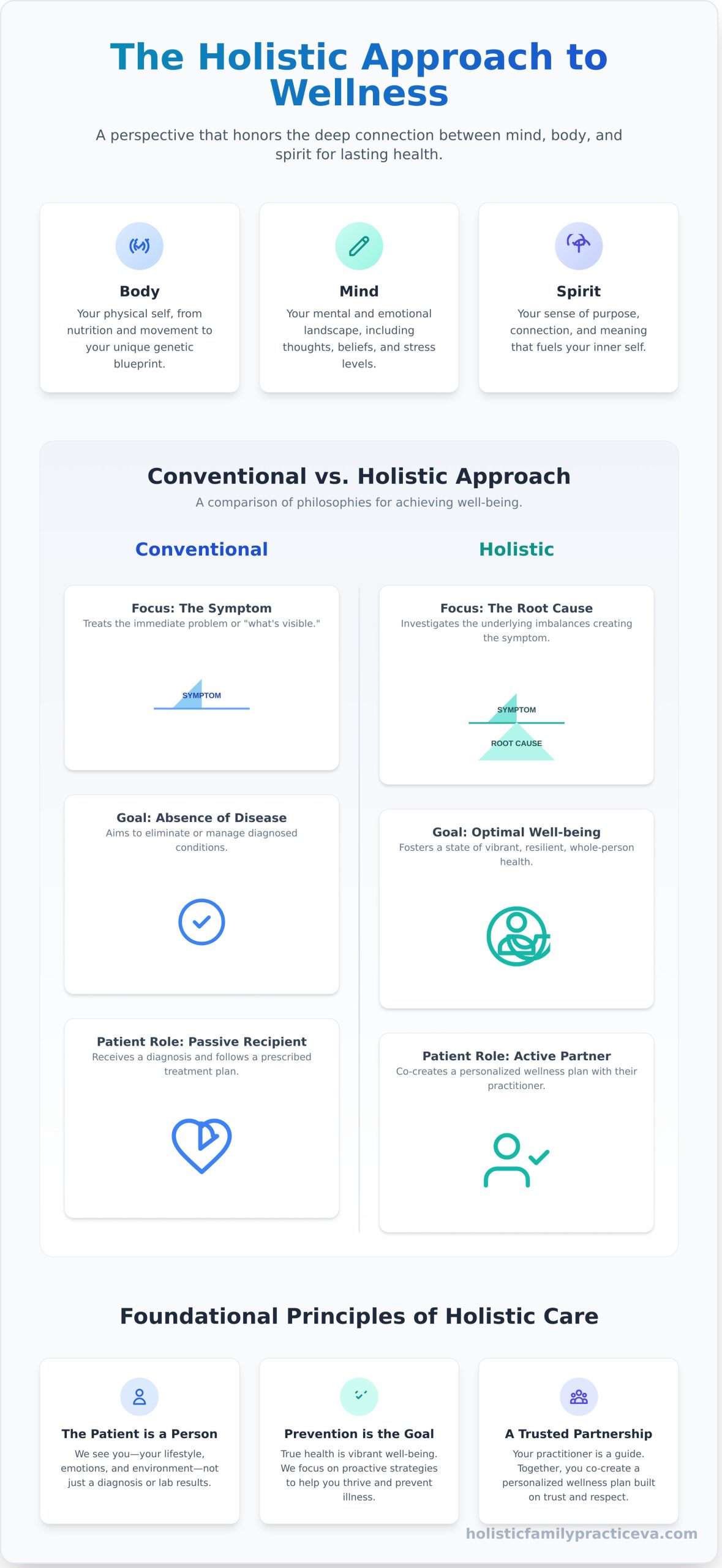
- Body: Your physical self-from the food that fuels you and the way you move to your unique genetic blueprint. We see physical symptoms as important clues from your body, not just problems to be silenced.
- Mind: Your mental and emotional landscape. This includes your thoughts, beliefs, stress levels, and the intuitive ways you process the world around you. Caring for your mind is essential for physical healing.
- Spirit: Your sense of purpose, connection, and meaning. This isn’t necessarily religious; it’s about what fuels your soul, whether that’s time in nature, connection with your community, or creative expression.
The Core Principles of a Holistic Health Approach
A holistic approach is more than just a treatment style; it’s a fundamental shift in perspective. Instead of focusing narrowly on a single symptom, we are guided by the principle of looking at the entire person-your mind, body, and spirit-to understand the complete picture of your health. This philosophy is built on a few core beliefs that empower you on your wellness journey.
Identifying the Root Cause
Imagine finding a water stain on your ceiling. You could simply paint over it, but the stain will always return because the leaky pipe above hasn’t been fixed. Conventional medicine can sometimes “paint over the stain” by managing symptoms with medication. Our approach is to find and fix the leaky pipe. For example, persistent skin issues or mood swings might not be isolated problems, but rather signals of an imbalance in your gut health. By addressing the root cause, we create lasting, genuine wellness. (To learn more about this deep-dive method, read our guide: What is Functional Medicine?)
The Practitioner-Patient Partnership
Your health journey is uniquely yours, and you are the expert on your own body. A practitioner’s role is to act as a trusted guide and partner, not a dictator. We listen deeply to your story, your experiences, and your goals. Together, we co-create a personalized wellness plan that feels authentic and achievable for you. This collaborative process is built on trust, respect, and the belief that you hold the power to heal.
This entire approach is guided by these additional foundational ideas:
- The Patient is a Person, Not a Disease: We see you-your lifestyle, your emotions, your environment-not just a diagnosis or a set of lab results. Your story matters.
- Prevention is the Ultimate Goal: True health isn’t just the absence of disease; it’s a state of vibrant well-being. We focus on proactive strategies to help you thrive and prevent illness before it starts.
These tenets, recognized as the core principles of holistic health by institutions like Western Connecticut State University, shift the focus from reactive symptom management to proactive, whole-person care that empowers you for a lifetime.
Holistic vs. Conventional Medicine: A Comparison, Not a Conflict
When you begin your wellness journey, it’s common to wonder where different medical philosophies fit. We encourage you to view holistic and conventional medicine not as opposing teams, but as two skilled players on your team, each with unique strengths. The goal isn’t to replace one with the other, but to create a supportive partnership that honors every part of you-mind, body, and soul. A common misconception is that this approach is ‘anti-science,’ but in reality, it deeply respects scientific principles to understand the root causes of your symptoms.
Key Differences in Approach
The primary distinction lies in perspective. While both seek to improve your health, their methods and focus differ. This Holistic vs. Conventional Medicine comparison from WebMD helps clarify that a holistic provider considers the whole person, not just the presenting issue. Think of it this way:
- Focus: Conventional medicine excels at managing acute symptoms, while a holistic approach seeks to uncover and resolve the root cause of those symptoms.
- Treatment: Conventional care often follows standardized protocols for specific diseases. Holistic plans are deeply personalized, tailored to your unique lifestyle, genetics, and environment.
- Scope: The conventional lens is typically focused on the specific disease or part of the body affected. The holistic lens widens to encompass the entire person-including emotional, spiritual, and mental well-being.
When to Use Each Approach
Understanding when to call on each philosophy is key to empowering your health journey. They are not mutually exclusive; they are situational partners in your care.
Conventional medicine is the undisputed champion of emergency and acute care. If you have a broken bone, a severe infection, or a heart attack, the targeted, rapid interventions of a hospital are exactly what you need.
Holistic medicine shines in managing chronic conditions, focusing on prevention, and optimizing your overall vitality. For long-term issues like chronic fatigue, digestive distress, or hormonal imbalances, it provides the tools to rebalance your entire system.
The most powerful path forward is often found in integrative medicine, which thoughtfully combines the best of both worlds. It uses the diagnostic precision of conventional medicine alongside the whole-person, root-cause solutions of holistic care. This is where true, sustainable wellness is born.
What Does a Holistic Health Plan Actually Look Like?
It’s one thing to understand the philosophy of whole-body wellness, but how does it translate into real, actionable steps? Let’s move from theory to practice. Imagine a client named Sarah who struggles with chronic headaches. A conventional approach might end with a prescription for pain medication. But a truly holistic plan looks at the complete picture of her life to uncover the root cause.
Instead of just masking the symptom, we partner with Sarah to explore interconnected areas of her well-being. Her personalized plan would be a gentle, supportive roadmap, likely including elements from the following areas.
Comprehensive Nutritional Support
We would explore what’s on Sarah’s plate, focusing on nourishment over restriction. This means incorporating anti-inflammatory foods like leafy greens, berries, and omega-3-rich fish. We might also investigate potential food sensitivities (like gluten or dairy) that can trigger inflammation and headaches. Simple, empowering steps like ensuring proper hydration and practicing mindful eating can also significantly reduce the body’s overall stress load.
Stress Management and Mental Wellness
Are Sarah’s headaches worse after a stressful day at work? We connect the dots between mental and physical symptoms. Her plan would include simple, sustainable stress-reduction techniques like a five-minute daily mindfulness practice or deep breathing exercises. We’d also emphasize the profound impact of quality sleep, as it’s crucial for regulating hormones and allowing the body’s natural healing processes to work effectively.
Movement and Physical Balance
Intense exercise could make Sarah’s headaches worse, so we’d focus on restorative movement. A plan could include gentle yoga to release tension in her neck and shoulders or daily walks to improve circulation and mood. To address potential structural imbalances, her wellness journey might also be supported by modalities like therapeutic massage or acupuncture, creating physical harmony and easing chronic tension patterns.
This integrated approach-addressing nutrition, stress, and physical alignment together-is the essence of a holistic health strategy. It’s not about finding a single cure, but about creating a supportive lifestyle that allows your body to find its own balance. Empowering your health journey begins with understanding that every part of you is connected.
Beginning Your Journey: How to Find a Holistic Practitioner
Embarking on a wellness journey is a powerful act of self-care, but you don’t have to walk the path alone. The right practitioner acts as a trusted guide, partnering with you to uncover the root causes of your health concerns and empowering you with the knowledge to heal. They listen to your full story, honoring the intricate connection between your mind, body, and spirit.
The world of holistic health includes professionals with diverse training. You may encounter Naturopathic Doctors (NDs) who focus on natural therapeutics, Medical Doctors (MDs) who integrate functional principles into their practice, and Doctors of Osteopathic Medicine (DOs) who emphasize the musculoskeletal system’s role in overall health. The key is finding an individual whose approach aligns with your personal wellness goals.
What to Look For in a Practitioner
Finding the right fit is about more than just credentials. Look for a practitioner whose philosophy resonates with you-someone who sees you as a whole person, not just a collection of symptoms. A true partner in your health will be committed to listening and willing to collaborate with your other healthcare providers to ensure comprehensive care.
Consider asking a potential practitioner:
- What is your approach to patient care and partnership?
- How do you get to the root cause of health issues?
- Are you open to collaborating with my primary care doctor?
Your First Step with Holistic Family Practice
Here in Virginia Beach, Dr. Erica Steele offers a compassionate and empowering approach to family wellness. At Holistic Family Practice, the focus is on root-cause analysis, helping you and your loved ones understand the “why” behind your health challenges. Dr. Steele is dedicated to creating a supportive space where you feel heard, validated, and equipped to take control of your well-being.
We believe the practitioner-patient relationship is sacred. That’s why we invite you to start with a conversation. A discovery call is a wonderful opportunity to share your story, ask questions, and see if our practice feels like the right home for your health journey.
Ready to feel truly supported? Book a complimentary discovery call to start your health journey.
Your Journey to Wholeness Begins Now
Embracing a holistic perspective is the first, most powerful step toward reclaiming your vitality. This approach is not about rejecting conventional medicine but about enriching it-seeing you as a complete person, not just a collection of symptoms. It’s a commitment to understanding the deep connections between your mind, body, and spirit and seeking the root cause of imbalance rather than only managing its effects. True wellness is about creating a sustainable, harmonious state of being.
Beginning this journey doesn’t have to be overwhelming. In the Virginia Beach community, Dr. Erica Steele and the team at Holistic Family Practice are dedicated to being your partners in health. As a trusted naturopathic doctor, Dr. Steele focuses on compassionate, root-cause analysis to create a personalized plan that empowers you. We believe in educating you, supporting you, and celebrating your progress every step of the way.
Empower your health journey. Book a discovery call today.
Frequently Asked Questions About Holistic Health
Is holistic medicine the same as naturopathic or functional medicine?
While they share a philosophy of treating the whole person, they aren’t identical. Holistic medicine is a broad approach considering the mind, body, and spirit. Naturopathic medicine is a distinct system using natural remedies, while functional medicine focuses on the scientific root cause of disease. Both are part of the broader holistic health movement, as they look beyond symptoms to support your entire being on its wellness journey and empower you with knowledge.
Is holistic care covered by insurance?
Insurance coverage can vary widely depending on the practitioner’s credentials and the specific service. Some treatments, like acupuncture or chiropractic care, may be covered by certain plans. We always encourage you to contact your insurance provider directly to verify your out-of-network benefits and understand what is eligible for reimbursement. We are happy to provide the necessary documentation to help you submit a claim and navigate this process with confidence.
What types of health conditions can a holistic approach help with?
A holistic approach is less about treating a single diagnosis and more about supporting your entire system to find balance. It can be incredibly beneficial for managing chronic conditions like digestive issues (IBS), hormonal imbalances (PCOS, thyroid), autoimmune disorders, and persistent fatigue. It also provides powerful tools for addressing stress, anxiety, and sleep disturbances by getting to the root of the problem rather than only managing the surface-level symptoms.
Do I have to stop seeing my regular doctor if I see a holistic practitioner?
Absolutely not! We believe in a collaborative and integrative approach to your health journey. Holistic care is designed to complement, not replace, the care you receive from your primary care physician or other specialists. We encourage open communication between all members of your healthcare team to ensure you receive comprehensive support. Think of it as adding another dedicated partner to your personal wellness team, empowering you from every angle.
Is there scientific evidence to support holistic medicine?
Yes, many therapies used within a holistic framework are supported by extensive scientific research. For example, the powerful impact of nutrition on chronic disease, the benefits of mindfulness for stress reduction, and the effectiveness of acupuncture for pain management are all well-documented. A credible practitioner integrates these evidence-based practices to create a personalized plan that honors both ancient wisdom and modern science, giving you a truly comprehensive path to wellness.
What can I expect during my first holistic health consultation?
Your first consultation is a compassionate, in-depth conversation where we get to know the whole you. Expect us to spend significant time listening to your story-exploring not just your physical symptoms but also your lifestyle, nutrition, stress levels, sleep patterns, and emotional well-being. This is a collaborative discovery process designed to uncover root causes and co-create the first steps on your personalized journey toward vibrant, whole-body health.