What if the path to true wellness mastery isn’t found in another late-night Google search, but in a structured, soul-aligned education? It’s completely understandable to feel overwhelmed. You’re trying to find credible, root-cause answers in a sea of conflicting advice, often questioning which qualifications truly matter. You know there’s a deeper truth to healing, but the path to learning it feels cluttered and confusing.
This is where we bring clarity to your journey. This guide is your definitive map for 2026, helping you distinguish between academic degrees and functional certifications. We’ll show you how to find the right holistic health education programs that provide a clinical-grade understanding of the body and empower you with actionable tools for profound, lasting wellness. From accredited university degrees to specialized clinical mastery courses, we will walk you through the top options so you can confidently choose the path that aligns with your personal or professional goals.
Key Takeaways
- Understand the crucial difference between “alternative” remedies and a true holistic approach that seeks the root cause of health imbalances.
- Discover whether a traditional academic degree or a specialized clinical mastery certification is the right fit for your personal and professional wellness goals.
- Gain the confidence to evaluate a curriculum by learning to spot red flags and recognize the importance of practitioner-led instruction.
- Learn how the right holistic health education programs bridge the gap between foundational science, like lab mastery, and practical, whole-person wellness strategies.
Defining Holistic Health Education: More Than Just a Degree
True wellness isn’t found in a prescription pad or a single piece of advice. It’s a journey of understanding. Holistic health education is the map for that journey. It’s an interdisciplinary study that honors the intricate connection between your physical, mental, emotional, and spiritual well-being. This isn’t about memorizing facts; it’s about developing an intuition for your body’s unique language and needs. It’s the first, most powerful step in taking back control of your health narrative.
Many people group these practices together, but there’s a vital distinction to be made. While the broader field of holistic health and alternative medicine includes a wide range of therapies, our approach focuses on identifying the why behind your symptoms. Instead of simply offering an alternative remedy, functional and naturopathic medicine ask critical questions. Why is your inflammation high? What is the root cause of your fatigue? We use advanced diagnostics to find the source of the imbalance, creating a targeted plan that supports your body’s innate ability to heal.
This is why education is the cornerstone of our “Empowering Your Health Journey” philosophy at Holistic Family Practice. We believe knowledge is the most potent medicine. Before we recommend a single supplement or lifestyle change, we ensure you understand the what, when, where, and why of your health plan. You become an active, informed partner in your own care, not a passive recipient. This collaborative approach transforms healthcare from something that happens to you into something you actively create.
The future of wellness is personal. By 2026, the paradigm will fully shift away from generic wellness advice toward deeply personalized, data-driven health education. One-size-fits-all diet plans and exercise routines are becoming obsolete. Your health plan will be built from your data, integrating everything from your genetic predispositions and current lab values to real-time feedback from your Oura Ring. This is the new standard of care.
The Evolution of Integrative Learning
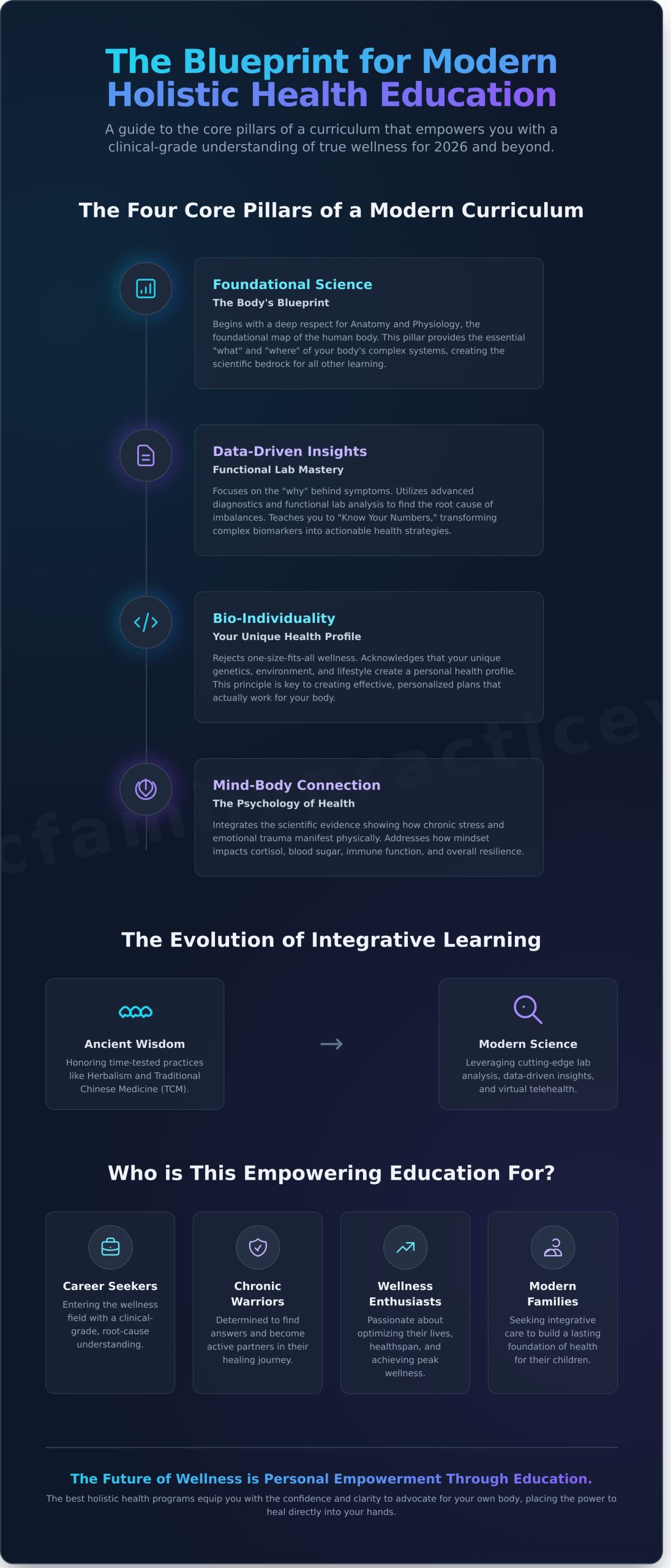
This approach isn’t new; it’s newly precise. The path began with ancient wisdom, like herbalism used in Traditional Chinese Medicine for over 2,200 years, and has evolved into the cutting-edge functional lab analysis we use today. The modern cornerstone of health literacy is to “Know Your Numbers,” transforming complex biomarkers into actionable insights. Now, with virtual telehealth, expert-led education from the world’s best practitioners is accessible from your living room, breaking down geographical barriers to wellness.
Who is Holistic Education For?
This empowering knowledge is for everyone. We see three main groups embracing these new learning opportunities: career-seekers entering the wellness field, chronic disease warriors determined to find answers, and wellness enthusiasts passionate about optimizing their lives. We also serve countless families seeking integrative primary care that educates them on building a foundation of health for their children. In 2026, health education is no longer just for practitioners – it is the essential toolkit for every individual seeking total health.
Ultimately, the best holistic health education programs are the ones that equip you with the confidence and clarity to advocate for your own body. They build a bridge between ancient wisdom and modern science, placing the power to heal directly into your hands. Your journey to mastery starts with a single question: are you ready to understand your body better?
The Core Pillars of a Modern Holistic Curriculum
True healing isn’t about finding a magic pill; it’s about understanding the beautiful, complex ecosystem that is your body. The best holistic health education programs don’t just teach you what to do. They empower you with the why behind it. They are built on a foundation of four essential pillars: the body’s physical blueprint, the data that reveals its inner workings, the uniqueness of your personal needs, and the undeniable link between your thoughts and your physical well-being.
It all begins with a deep respect for Anatomy and Physiology, the foundational map of the human body. But a map is only useful if you know how to read it for your specific journey. This is where bio-individuality comes in. Your genetics, your environment, and your lifestyle create a unique health profile. A diet that helps one person thrive might trigger inflammation in another. This core concept explains why generic, one-size-fits-all wellness plans so often fail, leaving you feeling frustrated and unseen.
Finally, these programs weave in the profound mind-body connection. We now have concrete scientific evidence showing how chronic stress and unresolved emotional trauma can manifest physically. When your body is in a constant state of “fight or flight,” your cortisol levels can rise, disrupting everything from blood sugar balance to immune function. Addressing your mental and emotional wellness isn’t a secondary goal; it’s an integral part of your physical healing journey.
Functional Medicine Lab Analysis
Learning to read your own lab work is a true mastery skill that puts you back in the driver’s seat of your health. It’s about learning to “Know Your Numbers.” A critical distinction taught is the difference between a “normal” lab range and an “optimal” one. For example, a conventional lab may flag a Thyroid-Stimulating Hormone (TSH) level as “normal” up to 4.5 mIU/L, but a functional perspective often views levels above 2.5 mIU/L as suboptimal and indicative of a struggling thyroid. Learning to interpret your own health data is a cornerstone of our patient education philosophy.
Naturopathic Principles in Education
Modern holistic education is deeply rooted in timeless naturopathic wisdom. The principle of Vis Medicatrix Naturae, or the “Healing Power of Nature,” trusts the body’s innate ability to heal itself when given the right support. Another key tenet is to identify and treat the root cause, rather than just suppressing symptoms. Instead of simply recommending an antacid for heartburn, a practitioner will investigate the underlying cause, whether it’s a food sensitivity or low stomach acid. This educational approach, where the doctor serves as a teacher (Docere), is central to the curriculum at leading institutions like the National Institute of Whole Health, empowering you to become an active, knowledgeable partner in your own wellness journey.
Comparing Career Paths: Academic Degrees vs. Clinical Mastery Programs
Your journey into holistic health begins with a crucial choice: which educational path will truly empower you? The road splits between traditional university degrees and specialized clinical programs. While both offer immense value, they serve different purposes. One builds a broad theoretical foundation, while the other equips you with the precise, actionable skills to guide others toward wellness right away. Understanding this difference is key to aligning your education with your ultimate calling.
University-Based Holistic Degrees
A formal degree, like the Bachelor of Science in Health Sciences from Vermont State University or the Minor in Holistic Health at San Francisco State University, provides a comprehensive academic grounding. These four-year programs, often costing between $40,000 and $120,000, delve into the history of healing, cultural practices, and broad wellness theories. This path is ideal if you’re aiming for a role in a traditional setting-such as a corporate wellness coordinator, a spa director, or a community health educator-where a B.S. is a standard requirement.
The primary challenge with this route is the “clinical application gap.” Graduates often possess a wealth of knowledge but lack the hands-on experience to confidently apply it in a one-on-one client setting. The focus is on theory, not the practical art of clinical assessment and personalized protocol design.
Specialized Clinical Courses and Webinars
A new wave of practitioner-led holistic health education programs is closing that gap. These are intensive, focused courses designed for immediate application. Think of them as “just-in-time” learning modules that give you the exact skills you need, when you need them. For example, a practitioner struggling to interpret complex lab results for a client with hypothyroidism can enroll in a targeted program like our “Functional Medicine Lab Panel Mastery” and gain confidence in weeks, not years.
Learning directly from an active clinician, like Dr. Erica Steele here in Virginia Beach, offers a distinct advantage. You gain insights from real, current patient cases, not just from textbooks written five years ago. This model offers:
- Efficiency: Master a specific skill in 6-12 weeks for a fraction of a university tuition, typically between $1,500 and $5,000.
- Relevance: Gain expertise in high-demand areas like metabolic syndrome, hormone balancing, or gut health.
- Empowerment: These courses also serve as a powerful bridge for individuals on their own health journey, helping them understand their bodies better before a personalized medical consultation.
Whether you choose a university degree or a clinical certification, always verify its credibility. For academic degrees, look for regional accreditation. For specialized courses, check for approval from professional organizations that offer Continuing Education Units (CEUs), such as the National Board for Health & Wellness Coaching (NBHWC). Your educational path is the first step in your mission to help others heal, so choose the one that truly equips you to make a difference.
How to Evaluate a Holistic Program for Your Health Journey
Choosing a path for your wellness journey is a deeply personal decision. The right program can empower you with lifelong tools, while the wrong one can lead to frustration and distrust. Your first step is to become a discerning student. Immediately dismiss any program that promises a “cure” for complex conditions like autoimmune disorders or claims to reverse chronic illness with a single, proprietary supplement. True healing is a process, not a magic pill. A credible program will always honor the integration of scientific evidence with holistic wisdom, not ask you to abandon one for the other.
Look beyond the curriculum to the person guiding you. Is the instructor an active, authentic practitioner who lives these principles? Or are they simply reciting information? An educator who has walked the path themselves brings an intuitive depth that a textbook can never offer. They should be able to explain the “what, when, where, and why” of your health plan from a place of genuine experience. The best holistic health education programs are built around this kind of authentic leadership.
A truly holistic approach must address the “Whole You.” Your body doesn’t operate in silos, and your education shouldn’t either. The program you choose must connect the dots between your physical symptoms and your inner world. Look for curricula that explicitly integrate these three pillars:
- Nutritional Mastery: Actionable guidance on anti-inflammatory eating, gut health protocols, and understanding your unique dietary needs.
- Mental & Emotional Resilience: Practical tools like mindfulness exercises, stress-reduction techniques, and strategies for emotional regulation.
- Actionable Protocols: Does the program provide downloadable guides, checklists, or daily routines you can implement immediately? Education without action is just information.
The “Wise Guide” Criteria
An effective practitioner’s intuition and compassion matter just as much as their clinical knowledge. This is the “soul” of their practice. Seek out a learning environment that feels supportive and validating, not rigid or judgmental. A 2018 study in the Journal of the American Medical Association confirmed that strong community support can improve health outcomes by up to 50%. A great program fosters this connection among its participants.
Practical Logistics and Accessibility
Your program must fit your life. Do you thrive with the energy of in-person learning, like the workshops available right here in Virginia Beach, or do you need the flexibility of an online format? A quality program will also empower you to “Know Your Numbers.” It should teach you to track key biometrics like your A1C, cortisol levels, and daily hydration in ounces, transforming complex data into a personal tool for managing your wellness journey.
Ultimately, the right program is a partnership. It respects your goals, provides you with practical tools, and supports you as a whole person. To see how we build these principles into our educational framework, explore our patient resources and workshops and start understanding your body better today.
Empowering Your Path: Educational Resources at Holistic Family Practice
True wellness isn’t just about receiving treatment; it’s about deeply understanding the language of your own body. At Holistic Family Practice, Dr. Erica Steele champions a revolutionary approach where education is a primary form of care. We don’t just identify the root cause of your symptoms. We empower you with the knowledge to become an active, intuitive partner in your own healing journey. This philosophy is the heart of our practice, transforming the traditional doctor-patient dynamic into a collaborative partnership built on wisdom and trust.
This commitment to your growth is woven into a complete ecosystem of learning resources. We’ve moved beyond the consultation room to build some of the most comprehensive holistic health education programs available online. These aren’t generic wellness tips. They are structured, actionable guides designed to meet you exactly where you are, whether you’re just starting to ask questions or you’re a professional seeking to deepen your expertise.
Online Courses and Webinars
Our virtual classroom offers a powerful suite of tools for self-discovery. The flagship program, Functional Medicine Lab Panel Mastery, empowers you to finally “Know Your Numbers.” This deep-dive course teaches you to decode more than 50 key biomarkers from your own lab results, transforming confusing data into clear insights about your health. For those beginning their journey, our free monthly “Total Health” webinars provide an accessible, inspiring first step. These virtual services ensure that no matter where you live, from Virginia Beach to anywhere across the globe, you have access to these life-changing resources.
Your Virginia Beach Holistic Partner
Education and personalized care go hand-in-hand. The knowledge you gain from our courses enriches your one-on-one consultations, allowing for deeper conversations and a more refined, effective health plan. We invite our neighbors in the 757 area to visit our welcoming office on Laskin Road to experience this integrated approach firsthand. We are committed to being your wise and nurturing guide on the path to vibrant health. Your journey to understanding your body better starts today.
Ready to take the first step? Let’s connect your personal health goals with a clear, supportive educational path. We believe our holistic health education programs can truly change your life by giving you the tools you need to succeed.
Empower Your Wellness Journey Beyond 2026
Choosing the right path in 2026 means looking beyond a simple diploma. It’s about finding a program that aligns with your personal and professional goals, whether you seek a traditional academic degree or a focused clinical mastery program. The best holistic health education programs equip you with the tools to understand the whole person, connecting mind, body, and spirit.
If you’re ready to move from learning to doing, we invite you to explore a path guided by expertise and compassion. For over 10 years, Dr. Erica Steele, a Board Certified Naturopathic Doctor, has empowered patients in Virginia Beach and virtually to identify the root cause of their health concerns through personalized wellness. You can begin that journey today. Start Your Education with Our Functional Medicine Lab Mastery Course and learn how to transform complex health data into a clear roadmap for wellness.
Your journey to becoming a confident, intuitive wellness advocate starts now.
Frequently Asked Questions About Holistic Health Education
What is the difference between a holistic health degree and a functional medicine certification?
A holistic health degree provides a broad, foundational education on whole-person wellness, while a functional medicine certification offers specialized, postgraduate training for licensed healthcare professionals. A four-year Bachelor of Science in Health and Wellness explores diverse modalities. In contrast, a certification from the Institute for Functional Medicine, which can take around 18 months to complete, equips doctors and nurses to find the root cause of complex chronic diseases using advanced diagnostic tools.
Can I practice as a holistic health coach with an online certificate?
Yes, you can absolutely practice as a holistic health coach with a certificate from a reputable online program. As of 2024, 48 U.S. states don’t require a state license for health coaching, but certification builds immense credibility and trust. To ensure quality, seek programs accredited by a body like the National Board for Health & Wellness Coaching (NBHWC). This credential shows you’ve met high standards for knowledge and ethical practice on your journey to empower others.
How do I know if a holistic health education program is scientifically sound?
You can determine if a program is scientifically sound by verifying its accreditation and examining its curriculum for evidence-based coursework. Look for accreditation from respected organizations like the National Association of Nutrition Professionals (NANP). A strong program will reference peer-reviewed studies from sources like the *Journal of Alternative and Complementary Medicine* and have faculty with advanced degrees (MD, ND, PhD), ensuring the information you learn is both authentic and well-researched.
Are there holistic health education programs specifically for patients, not just practitioners?
Yes, many wonderful programs are designed to empower you on your personal health journey, not just for professional certification. These often take the form of community workshops or online courses, like our 6-week “Wellness Mastery” series. These types of holistic health education programs focus on teaching you to understand your body, advocate for your needs, and take an active, informed role in your own wholesome wellness journey from the comfort of your home.
What subjects are typically covered in a holistic health curriculum?
A comprehensive holistic health curriculum typically covers clinical nutrition, mind-body medicine, botanical remedies, and stress management techniques. A 200-hour certificate program, for example, might dedicate 50 hours to nutrition, 30 hours to herbalism, and 20 hours to mindfulness practices like meditation and breathwork. The coursework always includes foundational anatomy and physiology to ensure you understand how every part of the “whole you” works together in harmony.
How much do holistic health education programs usually cost in 2026?
In 2026, you can expect the cost of holistic health education programs to range from under $1,000 for a single online certificate to over $40,000 for a four-year bachelor’s degree. For example, a specialized health coaching certificate from a provider like the Institute for Integrative Nutrition costs between $6,000 and $8,000. A Master’s degree in Integrative Health from an institution like Maryland University of Integrative Health can exceed $30,000, reflecting a deeper level of clinical training.
Is Virginia Beach a good location for in-person holistic health training?
Yes, Virginia Beach is an excellent location for in-person holistic health training, known as a vibrant hub for wellness education. It’s home to the renowned Cayce/Reilly School of Massage and Edgar Cayce’s Association for Research and Enlightenment (A.R.E.), a spiritual and holistic center since 1931. The city’s supportive community includes over 15 dedicated yoga studios and wellness centers, making it an inspiring environment to begin or continue your educational journey.
How does the “Know Your Numbers” philosophy apply to health education?
The “Know Your Numbers” philosophy is a core part of health education because it empowers you to transform clinical data into personal knowledge. It’s about learning what your specific biomarkers, like a fasting glucose under 100 mg/dL or a Vitamin D level above 30 ng/mL, truly mean for your unique body. This education turns confusing lab reports into an accessible tool for managing your health, allowing you to proactively get to the root of your well-being.