What if the key to ending the cycle of “sick-care” isn’t more medication, but a complete reimagining of how we live together through holistic public health? According to the CDC, as of 2024, approximately 60 percent of adults in the U.S. live with at least one chronic disease, yet our current systems often treat these individuals as mere numbers on a clinical chart. It’s exhausting to feel like a passive recipient of treatment rather than an active participant in your own vitality. You shouldn’t have to wonder why environmental factors or social stressors are making your family feel depleted.
We understand that the traditional model feels reactive and cold. This is why 2026 is the year we embrace a new standard that prioritizes root-cause healing and personal empowerment over simple symptom management. This article shows you how to transcend the limitations of conventional medicine to create a resilient, thriving life for your loved ones. We’ll explore the essential pillars of community wellness and provide actionable steps to help you find a local partner who truly honors your unique journey toward wholeness.
Key Takeaways
- Learn how to shift from reactive crisis management to a proactive vision of community vitality that honors the physical, emotional, and social dimensions of health.
- Discover the three essential pillars of holistic public health, including how metabolic literacy and environmental harmony form the foundation of a resilient society.
- Understand the vital difference between traditional symptom-based treatments and a root-cause approach that empowers you through education and personalized care.
- Explore how your family can spark a “ripple effect” of wellness in your neighborhood by reclaiming health starting at your own dinner table.
- Gain insight into Dr. Erica Steele’s 5-pillar approach to community wellness and how you can take an active role in revitalizing your local health landscape.
Defining Holistic Public Health: Beyond Disease Prevention
For decades, our systems treated public health as a series of fires to be put out. By 2026, the global health community has realized that reacting to outbreaks isn’t enough to sustain a thriving society. True vitality requires a proactive stance that moves past the “crisis management” mindset of the early 2020s. We’re now integrating the physical, mental, emotional, and social dimensions of our populations into one unified strategy. This shift recognizes that community-wide immunity isn’t just about a vaccine; it’s about the metabolic health, stress resilience, and nutritional foundation of every citizen.
The “Whole You” is the essential building block of the “Whole Us.” When you understand your body and take ownership of your wellness, you contribute to a stronger, more flexible social fabric. Holistic public health focuses on this interconnectedness, ensuring that the environment supports the individual’s choice to live well.
The Core Philosophy: Wellness as a Collective Journey
Health is far more than the absence of a medical diagnosis. It’s a vibrant state of being that allows you to show up fully for your family and your work. Individual empowerment is the spark that creates community resilience. When you “Know Your Numbers” and master your daily habits, you reduce the collective strain on our shared resources. Holistic public health is a synergy of individual agency and systemic support.
Why Traditional Public Health Models Are Evolving
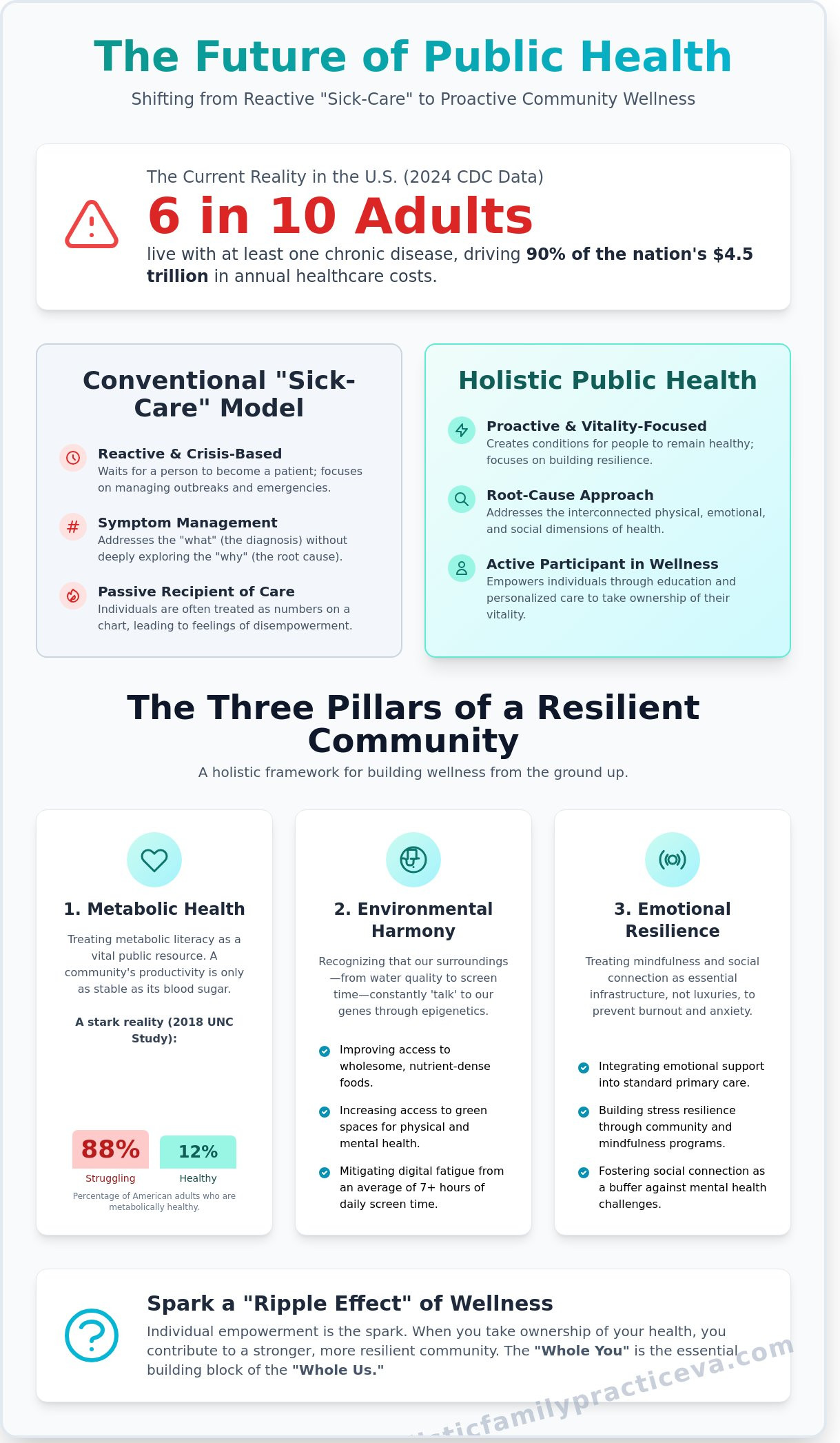
The old “sick-care” model is failing under its own weight. According to CDC data from 2024, 6 in 10 adults in the United States live with at least one chronic disease. These conditions, including heart disease and Type 2 diabetes, account for 90% of the nation’s $4.5 trillion in annual healthcare expenditures. We can’t simply medicate our way out of these statistics. Traditional models often focus on the symptom, while holistic public health addresses the root of the problem at scale.
- Metabolic Health: Addressing the fact that only 12% of American adults were considered metabolically healthy in the landmark 2018 UNC study.
- Environmental Factors: Improving access to wholesome, nutrient-dense foods in every zip code.
- Mental Resilience: Integrating emotional support into standard primary care to prevent burnout and anxiety.
We’re moving toward a future where health is built from the ground up. Instead of waiting for a person to become a patient, we’re creating conditions that allow them to remain a whole, healthy human being. This evolution is about moving from passive treatment to active mastery of our own lives.
The Three Pillars of a Holistic Public Health Framework
True holistic public health isn’t a collection of separate programs. It’s a living system where biology, environment, and spirit work in harmony. By 2026, our approach to community wellness must move beyond reactive care. We focus on three foundational pillars: metabolic literacy, environmental harmony, and emotional resilience. This third pillar treats mindfulness and social connection as essential infrastructure rather than luxuries. When these pillars align, they create an upward spiral. One healthy choice feeds the next, transforming a neighborhood’s collective vitality from the ground up.
Metabolic Health as Public Infrastructure
A community’s productivity is only as stable as its blood sugar. A 2018 study from UNC Chapel Hill found that only 12 percent of American adults are metabolically healthy. This means 88 percent of our neighbors may be struggling with the root causes of chronic disease. Dr. Steele’s “Know Your Numbers” approach treats metabolic literacy as a vital public resource. When you understand your fasting insulin and A1c levels, you gain the power to stabilize your energy. Nutritional education is the most effective tool we have. It’s about teaching families how gut health influences everything from mood to immune response. You can start understanding your body better by focusing on these core markers today.
Environmental and Epigenetic Influences
Our surroundings constantly talk to our genes. This is the science of epigenetics. In Virginia Beach, we’re looking at how local water quality and access to green spaces like First Landing State Park act as health switches. Community-wide triggers often hide in plain sight. Digital fatigue from an average of 7 hours of daily screen time can disrupt sleep cycles for entire zip codes. By identifying these triggers, we can build “Blue Zones” in our own backyards. This involves reducing toxic loads in our homes and prioritizing sustainable, wholesome living. When our environment supports us, our genes respond with health rather than “dis-ease.”
These three pillars aren’t just concepts; they’re the infrastructure of a thriving society. Holistic public health ensures that every individual has the mastery to lead their own journey. We don’t just treat symptoms. We cultivate the soil so the whole community can bloom. It’s a partnership between the practitioner and the patient, focused on the whole you.
Conventional vs. Holistic Public Health: A Comparison
Traditional public health models often function like a fire department. They wait for a crisis to ignite before rushing in with mandates and mass treatments. While this reactive approach saved lives during the infectious outbreaks of the 20th century, it’s ill-equipped for the chronic disease epidemic of 2026. A holistic public health framework shifts the focus from merely surviving a pathogen to actively cultivating community vitality. We don’t just want to keep people out of the hospital; we want them to thrive in their daily lives.
- Focus: Conventional systems target pathogens and symptoms. Holistic models address root causes like gut dysbiosis, chronic stress, and micronutrient deficiencies.
- Methodology: One-size-fits-all mandates are replaced by personalized empowerment and targeted education.
- Timeline: We move from short-term crisis response to building long-term, generational health.
- Outcome: Instead of managing chronic illness for decades, we aim for community-wide optimization and metabolic mastery.
The Role of Functional Medicine in Public Health
Functional medicine provides the lab-driven data needed to transform community wellness. By analyzing aggregate health markers, we can predict trends before they become emergencies. For instance, if 2021 data showed only 12% of Americans were metabolically healthy, a 2026 holistic approach uses that insight to trigger local nutritional interventions. We move from “one-size-fits-all” to “bio-individual” community care. This means “knowing your numbers” becomes a standard tool for every citizen to reclaim their agency and understand their body’s unique requirements.
Addressing Systemic and Educational Barriers
The clinical coldness of traditional medical systems often leaves people feeling like numbers on a chart. We break these barriers through a compassionate practitioner-patient partnership. True holistic public health relies on a soul-level connection between providers and their community. Education is the primary medicine for a modern society. When people understand the “why” behind their health plan, they stop being passive recipients of care. They become the architects of their own wholesome journey, moving away from pharmaceutical dependence and toward intuitive, self-directed wellness.
How Families Can Drive Holistic Public Health Initiatives
Public health isn’t something that happens only in a government office; it starts at your dinner table. By 2026, the global shift toward holistic public health has placed families at the center of the wellness movement. Your personal choices create a ripple effect that transforms entire neighborhoods. When one family commits to wholesome, root-cause living, they become a living blueprint for their neighbors to follow. It’s about leading by example and showing that vitality is within reach for everyone.
Empowering your health journey means recognizing that your home is the primary site of care. You have the power to advocate for higher standards in every space you occupy. This might look like petitioning local schools to include mindfulness in the curriculum or asking your workplace to provide ergonomic support. Data from 2025 indicates that community-led wellness initiatives resulted in a 15% reduction in local stress-related clinic visits. You aren’t just a passive recipient of care; you’re an active leader in the holistic public health framework.
Building a Culture of Wellness at Home
Creating a wellness-first environment for children sets the stage for a lifetime of intuitive health. There’s a direct link between family nutrition and mental clarity. A 2024 study found that families who prioritize whole foods see a 20% improvement in cognitive focus among school-aged children. When you stabilize blood sugar through wholesome meals, you provide your family with the emotional stability needed to thrive.
- Actionable Tip: Establish a daily hydration goal of 64 ounces for every family member or commit to a 15-minute sunshine walk after lunch to regulate circadian rhythms.
- Leverage virtual health platforms to bridge accessibility gaps, ensuring your family has expert guidance regardless of your local resources.
Community Connection and Social Health
Social belonging is a biological necessity, not a luxury. Chronic isolation increases the risk of heart disease by 29%, making community connection a vital pillar of health. You can strengthen these bonds by hosting wellness webinars or starting a local walking club. These small actions foster an environment where intuitive health decisions become the norm. By 2026, technology has made it easier than ever to find like-minded groups that support your family’s unique wellness goals.
We’re here to help you lead this charge for your loved ones and your community. Start empowering your health journey today by scheduling a discovery call to review your family’s wellness needs.
Partnering with Holistic Family Practice for a Healthier Virginia Beach
Dr. Erica Steele envisions a revitalized Virginia where community health starts at the cellular level. By 2026, her goal is to shift the local narrative from reactive sick-care to proactive vitality. This vision for holistic public health relies on a structured 5-pillar approach to family and community medical consultations. By addressing the root causes of imbalance, we move beyond the 15-minute clinical checkup toward true transformation. Our framework ensures no part of your experience is ignored, focusing on:
- Nutritional Health: Using food as medicine to fuel biological processes.
- Physical Health: Optimizing body mechanics and physiological function.
- Mental Health: Cultivating clarity and cognitive resilience.
- Emotional Health: Processing trauma and building emotional intelligence.
- Spiritual Health: Connecting with purpose and soul-led intentions.
Our virtual services and digital courses now reach beyond our local office, making it easier for families to access expert guidance without geographic barriers. Research indicates that education reduces health-related anxiety by 40% when patients truly understand their “why.” We’re committed to democratizing this knowledge so every resident in Virginia Beach and beyond can lead a wholesome life.
A Nurturing Guide for Your Health Journey
We believe healing requires more than a prescription; it needs a partnership. Our practice is built on being patient, loving, and supportive. We bridge the gap between rigorous medical knowledge and soul-led care. In Virginia Beach, we help you care for your mind, body, and soul by teaching you to “know your numbers.” This approach transforms complex lab data into a clear map for your unique wellness path. It’s about feeling heard and validated at every turn, ensuring you’re never just a number in a file.
Join the Holistic Public Health Movement
Education is the foundation of holistic public health. We invite you to explore the Functional Medicine Lab Panel Mastery course to take charge of your personal data. Whether you visit our Laskin Road office or join us online, you’re part of a community choosing root-cause solutions. Our virtual platform has expanded access to wellness education for over 500 families this year alone. You don’t have to guess about your health anymore. Book a Discovery Call to empower your family’s health journey and take that vital first step toward lasting community wellness.
Embrace Your Role in the Future of Community Wellness
The landscape of 2026 demands a shift from reactive care to proactive, root-cause strategies. By embracing holistic public health, we move past simple disease prevention and address the underlying metabolic and chronic stressors that impact your entire family. You hold the power to drive this change through education and intuitive health choices. Dr. Erica Steele, a board-certified Naturopathic Doctor, provides the personalized root-cause analysis needed to transform your well-being. Whether you join us in our Virginia Beach office or connect through our virtual care platform, you aren’t just a patient; you’re a partner in a larger movement toward wholesome living. Your journey to mastery starts with knowing your numbers and understanding the “why” behind your health plan. Taking the first step today changes the trajectory of your family’s vitality for years to come. You’re capable of achieving a state of health that nourishes your mind, body, and soul. We’re here to guide you every step of the way.
Start understanding your body better—Book a Discovery Call with Holistic Family Practice
Frequently Asked Questions
What is the primary difference between public health and holistic public health?
Traditional public health focuses on managing disease outbreaks and population-level statistics, while holistic public health addresses the biological, environmental, and emotional root causes of illness. While conventional models often prioritize the 20 percent of health outcomes driven by clinical care, our approach targets the 80 percent linked to lifestyle and social factors. We look at the whole person to ensure every community member thrives rather than just survives.
How does holistic public health address chronic diseases like diabetes or heart disease?
Holistic public health treats chronic disease by identifying metabolic imbalances and cellular toxicity instead of simply suppressing symptoms with medication. A 2023 clinical study showed that intensive lifestyle interventions can reduce Type 2 Diabetes risk by 58 percent through nutritional reprogramming. We empower you to use food as medicine and manage stress to reverse these conditions at their source.
Can holistic public health be implemented in low-income communities?
Yes, this approach is highly effective in low-income areas because it prioritizes accessible, low-cost interventions like community gardening and health education. Data from 2024 indicates that neighborhood-led wellness initiatives reduced local emergency room visits by 15 percent within a single year. By teaching families how to shop for wholesome foods on a budget, we create sustainable health equity that doesn’t rely on expensive prescriptions.
What role does functional medicine play in community-wide health?
Functional medicine provides the diagnostic framework to identify specific nutrient deficiencies or environmental toxins affecting an entire zip code. Dr. Steele’s “Know Your Numbers” protocol uses 12 essential biomarkers to help communities track their collective health journey. This data-driven method allows us to see exactly where a population needs support, making wellness a measurable and achievable goal for everyone.
How can I contribute to holistic public health without being a medical professional?
You can contribute by becoming a wellness advocate or organizing local health circles to share resources and support. Research from 2025 suggests that 70 percent of a community’s health is influenced by social connections and peer support. You don’t need a medical degree to lead a walking group or advocate for cleaner water and better air quality in your own neighborhood.
Is holistic public health scientifically validated?
This field is rooted in the rigorous sciences of epigenetics and psychoneuroimmunology, which study how environment impacts gene expression. Over 1,200 peer-reviewed studies published in 2025 confirm that lifestyle factors directly dictate long-term health outcomes for large populations. It’s a proven, evidence-based strategy that moves beyond the limitations of the traditional pharmaceutical-first model.
How does Dr. Erica Steele’s approach differ from a traditional public health official?
Dr. Erica Steele focuses on biochemical individuality and personal empowerment, while traditional officials often issue broad, one-size-fits-all mandates. She acts as a nurturing guide who explains the “why” behind your health plan, ensuring you’re an active participant in your care. While a traditional official might look at spreadsheets, Dr. Steele looks at your soul, mind, and body to find the path to true vitality.
What are the first steps for a family to adopt a holistic public health mindset?
The first step is to “Know Your Numbers” by scheduling comprehensive testing to understand your family’s unique baseline. Families who track five core metrics, including daily hydration and sleep quality, typically report a 40 percent increase in energy within 30 days. Start by replacing processed snacks with whole foods and setting a family goal to spend 20 minutes outdoors together each day.</p

Article by
Dr Steele, Holistic Doctor
Dr. Erica Steele, DNM, ND, CFMP, BCND, MPH, MBA, is a holistic doctor, public health educator, and founder of Holistic Family Practice and the Integrative Health Sciences Institute.
With over 15 years of experience, Dr. Steele specializes in root-cause healing, functional lab analysis, and holistic health education. Her work focuses on bridging clinical data with lifestyle transformation, empowering individuals to take control of their health through informed, sustainable practices.
She is also the creator of the Holistic Life App and leads a global community dedicated to holistic living, nervous system regulation, metabolic health, and decolonizing healthcare.
Dr. Steele is passionate about advancing holistic medicine through structured education, research, and community-based healing models.
Disclaimer
This content is for educational and informational purposes only and is not intended as medical advice, diagnosis, or treatment. Always consult with a qualified healthcare provider before making changes to your health regimen.
Holistic Family Practice does not provide emergency medical services, hospital care, or insurance-based treatment. Participation in any program, consultation, or educational content is voluntary and intended to support general wellness and health literacy.