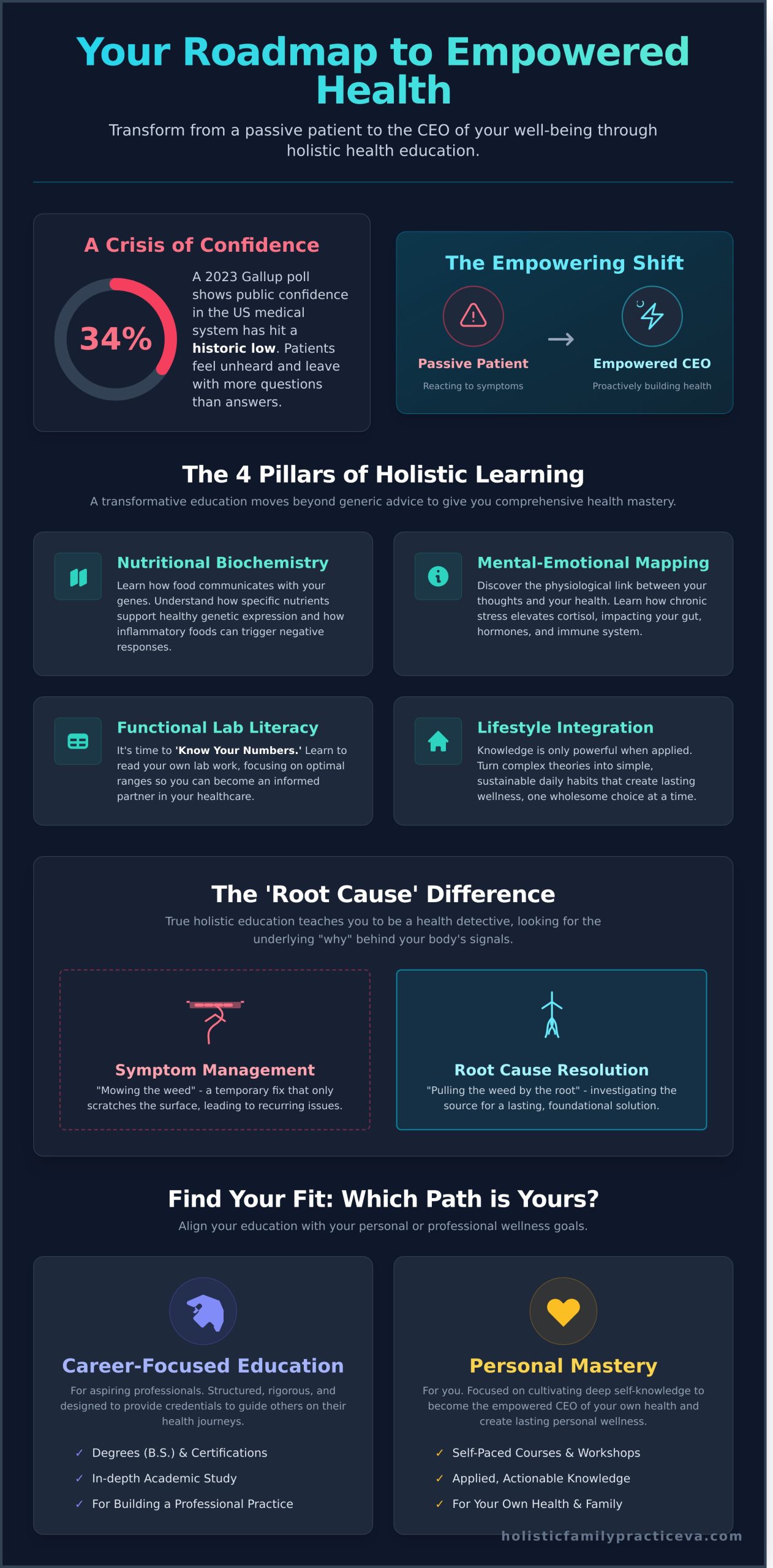
A 2023 Gallup poll revealed a startling fact: public confidence in the US medical system has plummeted to a historic low, with only 34% of Americans expressing trust. It’s a number that reflects a feeling many of us know all too well. You’re tired of the endless scroll of conflicting wellness advice and the frustration of leaving a doctor’s appointment with more questions than answers. You hold lab results in your hand, a sheet of numbers that should be a roadmap to your health, yet it feels like a foreign language.
This is where your empowerment begins. This guide is your starting point for a different kind of journey, one where you take the lead. We’ll show you how choosing the right holistic health education courses can help you move beyond just managing symptoms to truly understand the root causes of your unique biology. You’ll discover how to select a program that helps you finally ‘know your numbers,’ speak with confidence to your doctor, and create a personalized roadmap for your metabolic and mental health in 2026.
Key Takeaways
- Learn how holistic health education transforms you from a passive patient into the empowered CEO of your own well-being.
- Discover the key differences between academic, professional, and personal mastery programs to find the path that aligns with your unique wellness goals.
- Gain a simple framework for evaluating holistic health education courses, ensuring you choose programs that are evidence-based and taught by credible experts.
- Pinpoint your specific health challenges and current knowledge level to select a course that directly addresses your needs and helps you achieve tangible results.
What is Holistic Health Education and Why Does it Matter Now?
Are you tired of feeling like a passenger in your own health journey? For too long, the conventional model has positioned us as passive recipients of care, waiting for a diagnosis to react to. But a powerful shift is underway. We are moving from being patients to becoming the empowered CEOs of our own well-being, and it all starts with a different kind of learning. This isn’t just about knowing basic nutrition; it’s about deep, multi-dimensional health mastery.
True Holistic health education recognizes that you are a whole person, not an isolated set of symptoms. It’s an approach that honors the intricate connections between your body, mind, and spirit. This matters more than ever because our old methods are failing us. With 6 in 10 adults in the U.S. living with at least one chronic disease, according to the Centers for Disease Control and Prevention, it’s clear that simply managing symptoms isn’t enough. We need an educational framework that equips us to understand our unique bio-individuality and prevent illness before it takes hold.
Beyond the Basics: The 4 Pillars of Holistic Learning
A transformative education moves far beyond generic advice. The best holistic health education courses are built on four foundational pillars that empower you with comprehensive knowledge:
- Nutritional Biochemistry: This is where you learn how food communicates directly with your genes. It’s not just about calories; it’s about understanding how nutrients like folate can support healthy genetic expression and how inflammatory foods can trigger negative responses.
- Mental-Emotional Mapping: Discover the physiological link between your thoughts and your health. You’ll learn how chronic stress elevates cortisol, which can directly impact your gut health, disrupt your hormones, and weaken your immune system.
- Functional Lab Literacy: It’s time to ‘Know Your Numbers.’ This pillar teaches you to read and understand your own lab work, focusing on optimal ranges rather than the standard “not sick yet” ranges. You become a partner in your own healthcare, able to ask informed questions.
- Lifestyle Integration: Knowledge is only powerful when applied. This final pillar is dedicated to turning complex theories into simple, sustainable daily habits that create lasting wellness, one wholesome choice at a time.
The ‘Root Cause’ Difference in Education
Many wellness programs only scratch the surface. They might offer a recipe for a “de-bloating” smoothie without ever asking why you are bloated in the first place. Is it a food sensitivity, a gut microbiome imbalance, or a stress response? This is where an education grounded in functional medicine principles truly stands apart. It teaches you to be a health detective, looking for the underlying “why” behind your body’s signals.
Instead of just placing a bandage on a symptom, this approach gives you the tools to investigate the source. It’s the difference between constantly mowing over a weed and pulling it out by the root. Root Cause Education is the identification of physiological imbalances before they become diagnoses. It’s the ultimate form of proactive, empowered self-care, giving you the wisdom to nurture your body from its very foundation.
Types of Holistic Health Education Courses: Finding Your Fit
Your journey into wellness begins with a single, powerful question: What do you want to learn? The world of holistic health education courses is wonderfully diverse, but its sheer size can feel overwhelming. Don’t worry. This isn’t a test; it’s an opportunity to align your education with your soul’s purpose. Whether you dream of becoming a practitioner or simply wish to become the empowered CEO of your own health, there’s a path designed for you. The key is to understand the fundamental difference between building a career and cultivating personal mastery.
Let’s break down the main pathways so you can find your perfect fit. The field of holistic health is broad, incorporating a spectrum of approaches that the National Center for Complementary and Integrative Health helps to define, so choosing a focused program is essential for success.
Career-Focused Education (Degrees & Certifications)
This path is for the aspiring professional. It’s structured, rigorous, and designed to provide the credentials needed to guide others. These programs are about building a foundation of knowledge you can use to serve your community. Think of it as learning the language of healing so you can translate it for others.
- Bachelor of Science (B.S.) in Holistic Health: This is a deep academic dive. A four-year degree program integrates anatomy, physiology, and biochemistry with nutrition, mind-body medicine, and herbalism. It’s the ideal starting point for those who plan to pursue advanced degrees or work within integrative medical settings.
- Health Coaching Certifications: With the health coaching market projected to grow over 8% annually to reach $25.95 billion by 2030, this is a powerful and in-demand role. A certification, which can take anywhere from six to 12 months, equips you to bridge the critical gap between a doctor’s diagnosis and a patient’s daily life. You become the supportive guide who helps turn a health plan into a sustainable lifestyle.
- Continuing Education Units (CEUs): Already a licensed professional like a nurse, therapist, or chiropractor? CEUs in holistic modalities allow you to integrate new skills into your existing practice. Completing a 15-hour CEU course in functional nutrition, for instance, can immediately enhance the care you provide.
Personal Mastery Courses (The Empowered Patient Path)
What if your primary goal is your own well-being? This path is for you. It’s about taking back your power and learning to listen to your body’s intuitive wisdom. These shorter, highly-focused holistic health education courses transform you from a passive patient into an active, knowledgeable participant in your own health journey.
- Condition-Specific Deep Dives: These courses offer mastery over a single area. You can find programs focused on Thyroid Mastery, healing gut permeability, or reversing metabolic dysfunction. They provide targeted strategies you can implement right away.
- Lab Masterclasses: Stop feeling confused by your bloodwork. A lab masterclass teaches you how to “Know Your Numbers,” transforming a page of data into a clear story about your health. You’ll learn what optimal ranges really are, not just the “normal” ones.
- Mind-Body Techniques: Explore the profound connection between your mind and your physical health through courses on meditation, breathwork, or somatic healing. These skills are foundational to managing stress and cultivating inner peace. Understanding these concepts is the first step, and if you’re ready to apply them, you can explore our patient-focused guides to begin your journey.
In recent years, we’ve seen the rise of “micro-learning” in this space. Instead of committing to a year-long program, you can now take a 90-minute webinar on interpreting your genetic data or a three-week course on creating an anti-inflammatory kitchen. This allows for incredible flexibility. You can choose between self-paced webinars that fit your schedule or join an interactive clinical cohort where you benefit from community support and direct mentorship. The right choice simply depends on how you learn best.
How to Evaluate the Quality of a Holistic Health Course
Your health journey is deeply personal, and the education you choose to support it should be just as carefully selected. With so many online programs available, it’s easy to feel overwhelmed. How can you distinguish a truly transformative course from a superficial one? It starts with learning to look beyond the marketing and evaluate the core substance of the program. Your goal is to find a guide, not just a guru.
To truly feel empowered, you need an education that is credible, practical, and supportive. Before you invest your time and money, ask these critical questions to assess the quality of any holistic health education courses you’re considering:
- Who is teaching? Check the instructor’s credentials. Are they a Medical Doctor (MD), a Naturopathic Doctor (ND), a PhD researcher, or a certified health coach? Each brings a different perspective. A program’s quality is often reflected in its academic rigor; even major universities now recognize the field’s importance, with institutions like Western Connecticut State University establishing a dedicated Institute for Holistic Health Studies. Look for instructors with a verifiable, accredited background in health or science.
- Is it evidence-based? Authentic holistic health honors both ancient wisdom and modern science. A great course won’t rely solely on anecdotal success stories. It will cite clinical research and provide links to studies on platforms like PubMed. A syllabus that includes a reference list of at least 10-15 peer-reviewed articles is a strong sign of scientific integrity.
- Does it offer practical tools? Information is only powerful when you can apply it. Does the course provide downloadable action plans, meal guides, or self-assessment worksheets? The best programs are designed to help you build real-world skills and integrate new habits into your daily life.
- Is there community support? Your journey shouldn’t be a lonely one. Look for courses that offer a private community forum, live Q&A sessions with the instructor, or opportunities to connect with fellow students. This support system is invaluable for asking questions and staying motivated.
The ‘Red Flags’ of Wellness Education
Be a discerning student. Some programs are more focused on profit than on your well-being. Watch out for rigid, ‘one-size-fits-all’ protocols that ignore your unique biology. If every module seems to conveniently end with a sales pitch for a specific brand of supplements, you’ve likely found a hidden sales funnel, not a genuine educational experience. Finally, be wary of outdated biological models or a complete lack of scientific grounding.
The Value of Clinical Experience
There’s a profound difference between a teacher who only knows the theory and one who has guided hundreds of patients to wellness. An instructor with active clinical practice brings a layer of wisdom that can’t be found in a textbook. They share real-world case studies, troubleshoot common obstacles, and teach with an ‘Authenticity in Practice’ that comes from walking the path alongside their patients. This experience is what transforms abstract concepts into life-changing results.
Choosing the Right Course for Your Health Journey
Selecting the right program is the first active step you take toward reclaiming your vitality. It’s an act of self-empowerment. With hundreds of options available, from quick webinars to in-depth certifications, finding the perfect fit requires more than a quick search; it demands a moment of honest self-reflection. Your unique body, goals, and learning preferences are the map you’ll use to navigate the world of holistic health education courses and find the one that truly serves you.
First, consider where you are right now. Are you a beginner, perhaps recently diagnosed with a condition like Hashimoto’s and feeling overwhelmed by conflicting information? Or are you an advanced student of your own body, someone who has been tracking biometrics for years but wants to optimize your mitochondrial health? A beginner might thrive in a foundational course on anti-inflammatory nutrition, while an advanced learner may need a specialized masterclass on interpreting complex lab work, like the DUTCH test.
Next, get specific about your primary challenge. Vague goals lead to vague results. Instead of searching for a course on “feeling better,” target your most pressing ‘pain point.’ If you struggle with persistent brain fog after recovering from a viral infection, seek out a program focused on neuroinflammation and cognitive recovery. If chronic fatigue is your reality, a course on adrenal support or cellular energy production will provide far more value than a general wellness overview. The goal isn’t just to gather information; it’s to find actionable solutions for your specific symptoms.
Step 1: Define Your ‘Why’
Your motivation is your compass. Are you on a mission to heal yourself, to finally understand the root cause of your symptoms? Or do you feel a calling to guide others on their own paths to wellness? Clarifying this purpose will help you choose between a personal development course and a professional certification. Setting clear educational goals is a foundational part of Building Your Personalized Wellness Journey and ensures your investment of time and energy pays off.
Step 2: Match the Course to Your Learning Style
How you best absorb and apply new knowledge is critical. The most brilliant information is useless if it isn’t presented in a way that clicks for you. Don’t force yourself into a format that feels draining. Instead, lean into your natural tendencies:
- Visual Learners: You thrive with demonstrations. Look for courses rich with video modules, detailed infographics, and live webinars where you can see concepts explained.
- Analytical Learners: You need the data. Seek out lab-heavy masterclasses that include sample reports, case studies, and evidence-based protocols. The “why” behind the “what” is everything to you.
- Action-Oriented Learners: You’re ready to do. The best fit for you are programs that provide checklists, downloadable workbooks, and clear ‘Mastery’ guides that translate theory into daily practice.
Finally, commit to mastery over a mere overview. A 60-minute webinar can spark an idea, but a comprehensive 8-week program is what creates lasting transformation. An overview skims the surface. Mastery empowers you with the deep knowledge and practical skills to become the authority on your own health. The best holistic health education courses are designed for this kind of deep dive. If you’re ready to find the structured, supportive guidance that leads to true mastery, explore our guided masterclasses and take control of your health.
Empower Your Journey with Holistic Family Practice Courses
True wellness isn’t a passive state; it’s an active, personal journey. At Holistic Family Practice, Dr. Erica Steele’s philosophy is built on this core belief: you are the most powerful agent of change in your own health story. Our mission is to provide you with the tools and knowledge to step into that role with confidence. We’ve designed our programs to transform complex medical information into intuitive wisdom, empowering you to become a true partner in your care. These dynamic holistic health education courses bridge the gap between our dedicated clinical care in Virginia Beach and your home, wherever that may be.
This commitment to education is the driving force behind our ‘Know Your Numbers’ initiative. We believe that your health data isn’t just for your doctor’s file; it’s your personal roadmap to vitality. When you understand what your lab results truly mean, you move from being a passenger to the driver of your health journey. Data becomes power.
The Functional Medicine Lab Panel Mastery Course
Imagine walking into your next doctor’s appointment feeling confident, informed, and ready to ask insightful questions. That is the goal of our Functional Medicine Lab Panel Mastery course. This program demystifies three of the most fundamental blood tests:
- Complete Blood Count (CBC): Understand the health of your red and white blood cells, which can reveal insights into everything from anemia to your immune response.
- Comprehensive Metabolic Panel (CMP): Learn what your kidney function, liver health, and electrolyte balance say about your body’s daily performance.
- Full Thyroid Panel: Go beyond a simple TSH test to analyze Free T3, Free T4, and thyroid antibodies, getting a complete picture of your metabolic engine.
We teach you to look beyond the conventional “normal” ranges found on lab reports, which often represent a population average rather than peak health. Instead, you’ll learn to identify the optimal functional ranges where your body can truly thrive, allowing you to take proactive steps toward vitality long before a diagnosis appears.
Start Your Education Today
Are you ready to take the first step? Your path to health mastery is more accessible than ever. We offer a growing library of virtual webinars and downloadable guides designed to fit into your life. These resources provide foundational knowledge and practical tips you can implement immediately, serving as your entry point into a more empowered way of living.
For those seeking a truly integrated experience, this education becomes the perfect complement to a Holistic Medical Consultation with our team. By understanding your body better, you enhance the quality of your clinical care, enabling deeper conversations and more personalized, effective treatment plans. You become an active collaborator in your own healing process.
Don’t let confusion or uncertainty dictate your well-being. Your body is communicating with you every single day. It’s time to learn its language. Explore our educational offerings and take the definitive step toward mastering your health today.
Master Your Wellness Journey in 2026
Your path to vibrant health is a personal journey, not a one-size-fits-all prescription. As we’ve explored, selecting the right program means understanding your unique needs and learning how to evaluate a course’s quality and focus. The most effective holistic health education courses empower you to move beyond simply managing symptoms and start addressing the root causes of your health concerns, creating a foundation for lasting well-being.
If you’re ready to take that first empowered step, understanding your body’s own data is essential. That’s why Dr. Erica Steele, a Board Certified Naturopathic Doctor with over 22 years of experience, designed a compassionate, root-cause focused curriculum. It’s time to achieve true clinical literacy and finally ‘Know Your Numbers’. Don’t just guess about your health. Master it. Enroll in our Functional Medicine Lab Panel Mastery Course today and start translating your body’s messages into decisive action.
Your most authentic, vibrant self is waiting. Your journey begins with this single, informed choice.
Frequently Asked Questions About Holistic Health Education
Can I take holistic health courses if I have no medical background?
Yes, you absolutely can. Most foundational programs are designed for individuals passionate about wellness, not just medical professionals. They begin with core principles of nutrition, mind-body connection, and lifestyle adjustments. For example, over 90% of students enrolling in introductory nutrition coaching programs in 2023 reported having no prior clinical background. These courses are built to empower your personal health journey from the very beginning.
Are online holistic health courses recognized by traditional doctors?
Recognition is growing significantly as integrative medicine becomes more mainstream. While not a substitute for a medical degree, a certificate from a credible institution shows your dedication to wellness. A 2022 study from the Academic Consortium for Integrative Medicine & Health found that over 75% of U.S. medical schools now include holistic or integrative topics in their curriculum. This shared knowledge helps foster more collaborative and effective patient care.
What is the difference between a health coach and a holistic practitioner?
The primary difference is their scope of practice. A health coach is a supportive mentor who helps clients implement lifestyle changes and achieve goals set with their primary provider. A holistic practitioner often has deeper training in specific modalities, like herbalism or functional nutrition, and may assess underlying imbalances to develop a comprehensive wellness plan. A coach helps you follow the map; a practitioner can help you draw it.
How much do holistic health education courses typically cost in 2026?
In 2026, the cost for holistic health education courses is projected to span a wide range, from $400 for a weekend workshop to over $18,000 for an advanced, year-long certification. For instance, a typical health coaching certification from a recognized institution like the Institute for Integrative Nutrition costs approximately $7,000. It’s vital to weigh the curriculum, instructor credentials, and level of support when comparing prices.
Will these courses teach me how to read my own blood work?
Some advanced courses will teach you how to analyze blood work from a functional perspective. While introductory programs focus on broader wellness topics, specialized certifications in functional nutrition provide training to interpret lab results. They teach you to look for optimal ranges, not just clinical disease markers. Our “Know Your Numbers” workshop is specifically designed to help you understand this data and take control of your health story.
Can I get a job with a holistic health certificate?
Yes, a certificate can launch a rewarding career in the wellness industry. The U.S. Bureau of Labor Statistics projects a 17% growth for health education specialists between 2021 and 2031, much faster than the average for all occupations. Graduates find roles as corporate wellness consultants, health coaches in integrative clinics, or start their own private practices. It’s a credible credential that validates your expertise and passion.
How do I know if a holistic health course is scientifically accurate?
You can verify a course’s credibility by checking for accreditation and reviewing the curriculum’s sources. Look for programs recognized by bodies like the National Board for Health & Wellness Coaching (NBHWC). A trustworthy course will provide evidence-based information, cite peer-reviewed studies for its claims, and clearly distinguish between established science and traditional or theoretical concepts. This transparency is key to a valuable education.
Does Holistic Family Practice offer virtual courses for out-of-state residents?
Yes, we are thrilled to offer our complete selection of virtual holistic health education courses to everyone in the United States. Our online programs deliver the same compassionate, expert-led guidance as our in-person sessions. We believe your location should never be a barrier to wellness, so our digital classroom provides the tools and supportive community you need to begin your health journey from anywhere.