What if you could stop being a passive passenger in your own body and finally take the driver’s seat? You’ve likely spent hours scrolling through conflicting health blogs, only to feel more overwhelmed than when you started. A 2023 report indicates that 38% of adults now seek out complementary health approaches, yet many still struggle to find a clear starting point. You deserve to move beyond the confusion of learning holistic medicine and find a path that truly resonates with your soul. If you’re tired of feeling like a passive recipient of healthcare, you aren’t alone in that search for deeper answers.
I’m here to offer you a comprehensive roadmap that clears the fog between naturopathic, functional, and integrative approaches. We’ll explore exactly how you can master your own health data and gain the confidence to advocate for the whole you. This guide outlines specific educational paths and practical tools to help you transition from a curious seeker to a knowledgeable practitioner or a self-assured advocate for your family’s daily wellness.
Key Takeaways
- Understand the systems-based approach that shifts the focus from masking symptoms to identifying the root cause of dysfunction in your mind, body, and soul.
- Explore diverse professional routes, including the journey to becoming a licensed Naturopathic Doctor or gaining functional medicine certifications for existing health careers.
- Discover how learning holistic medicine empowers you to master your own biology by starting with simple, actionable steps like self-awareness and tracking daily wellness goals.
- Master the core pillars of health, such as viewing nutrition as vital information for your cells and understanding the deep impact of the mind-body connection.
- Learn how a personalized “Total Health” model bridges the gap between professional consultation and deep patient education for a truly transformative healing journey.
What is Holistic Medicine? Defining the Educational Landscape
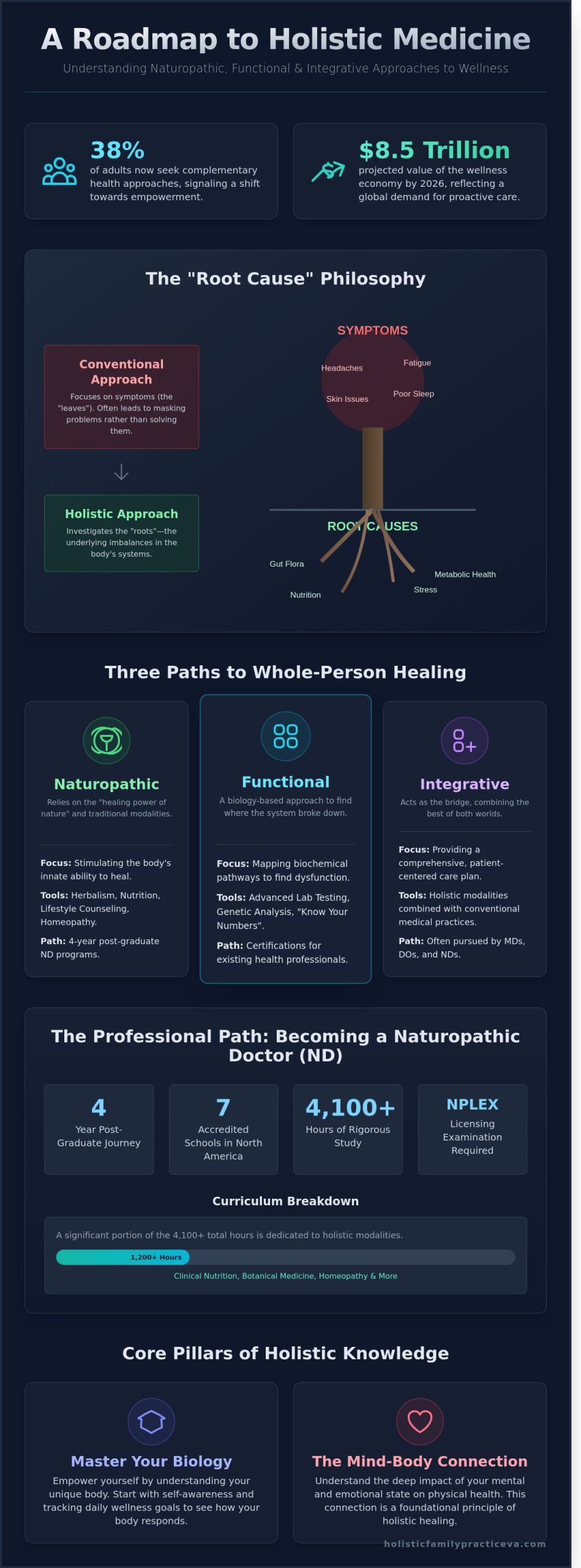
Holistic medicine is a systems-based approach that treats the whole person. Practitioners don’t view a headache or chronic fatigue as an isolated event. Instead, the focus remains on the mind, body, and soul as a beautifully interconnected web. When you begin learning holistic medicine, you’re stepping into a partnership. This path is a journey where the practitioner and the student work together to restore balance. By 2026, the Global Wellness Institute projects the wellness economy will reach $8.5 trillion. This growth reflects a massive shift in how we view our bodies. People don’t want to be passive recipients of care anymore. They want to be empowered.
A central part of this education involves Understanding Holistic and Alternative Medicine within the context of modern healthcare. This isn’t about rejecting science. It’s about expanding it to include the “Whole You.” We focus on why a dysfunction exists rather than just what the symptoms are. This proactive model is why educational demand is surging. Students today seek to guide others through wholesome, intuitive care that honors the individual’s unique biology. You’re not just learning facts; you’re gaining mastery over the language of the body.
The “Root Cause” Philosophy
Think of your health as a tree. Conventional medicine often spends its time trimming the brown leaves. Holistic medicine looks at the soil. If the roots are thirsty or the soil lacks minerals, the leaves will always wither. Learning to think this way changes how you view chronic disease. You start asking deep questions about metabolic health and gut flora. Bio-individuality is the key here. A 2023 study published in Nature showed that individuals respond differently to the exact same foods. One-size-fits-all education fails because every body is a different ecosystem. Your role is to find the specific keys that unlock health for each person.
Naturopathic vs. Functional Medicine
These paths often overlap, but their educational foundations have distinct flavors. Naturopathic medicine relies on the “healing power of nature.” It uses traditional modalities like herbalism, nutrition, and lifestyle counseling. Accredited programs typically require 4 years of intensive post-graduate study. Functional medicine is a biology-based approach. It maps out complex biochemical pathways to find where the system broke down. While both seek the root cause, functional medicine often uses advanced lab testing to “Know Your Numbers.” Integrative medicine acts as the bridge. It combines these holistic tools with conventional medical practices to provide a comprehensive care plan. Learning holistic medicine requires you to choose the lens that fits your soul’s calling. Whether you choose the path of the naturopath or the functional practitioner, you’re becoming a nurturing guide in a world that’s hungry for authentic healing.
Professional Paths: How to Become a Holistic Health Practitioner
Choosing a career in wellness is more than a professional shift; it’s a commitment to a new way of seeing the world. It’s a calling. When you begin learning holistic medicine, you’re stepping into a role as a nurturing guide for others. This path requires a balance of scientific mastery and intuitive connection. Whether you’re starting from scratch or adding to an existing medical license, the route you take determines how you’ll eventually help patients get to the root of their health challenges. Authentic practice must come from the soul, but it also needs a foundation in evidence-based science.
Accredited Medical Programs (ND)
The most comprehensive path for new students is becoming a Naturopathic Doctor (ND). There are currently 7 accredited schools in North America recognized by the Association of Accredited Naturopathic Medical Colleges (AANMC). This 4-year post-graduate journey involves over 4,100 hours of study, combining traditional medical science with natural therapies.
- Core Sciences: Students dive deep into biochemistry, anatomy, and clinical physical diagnosis.
- Holistic Modalities: The curriculum includes 1,200 hours of clinical nutrition, botanical medicine, and homeopathy.
- Licensure: Graduates must pass the NPLEX (Naturopathic Physicians Licensing Examinations) to practice.
This rigorous training ensures you understand the Principles of Holistic Medicine while practicing safely within a modern medical framework. Scope of practice varies by state, but NDs are trained to act as primary care providers who view the “Whole you” rather than just a set of symptoms.
Functional Medicine Certifications
For existing MDs, RNs, or health coaches, the Institute for Functional Medicine (IFM) provides a specialized pivot. Their IFM Certification Program (IFMCP) has been a leader in the field since 1991. The curriculum uses modular learning to cover the six core physiological systems that govern human health.
Practitioners study the immune, hormone, cardiometabolic, and gastrointestinal systems in great detail. Staying current with advanced functional medicine research is a lifelong process. Since science evolves rapidly, continuing education is required to maintain certification. This path allows conventional providers to expand their toolkit, helping them move beyond symptom management and empower their patients to take an active role in their own healing journey.
Accreditation is the cornerstone of professional credibility. Choosing a recognized institution, such as the Virginia University of Integrative Medicine, ensures your education meets high standards of academic and clinical excellence. Without proper accreditation, your ability to secure insurance or professional recognition may be limited. Beyond the classroom, clinical mentorship is vital for your growth. Working under a seasoned provider helps you master hands-on lab analysis. You’ll learn to “Know Your Numbers” by interpreting complex tests like organic acid profiles, comprehensive stool markers, or advanced hormone panels. This practical experience transforms a student into a confident, powerful practitioner.
If you’re curious about how this specialized knowledge translates into real-world patient care, you can start understanding your body better by reviewing how we apply these tools in our clinical practice. Learning holistic medicine is a marathon, not a sprint. It requires a dedicated heart and a sharp mind to bridge the gap between ancient wisdom and modern clinical data. Every hour spent in a lab or a lecture hall is an investment in your future ability to provide patient, loving, and supportive care for the mind, body, and soul of every person who walks through your door.
The Empowerment Path: Learning Holistic Medicine for Personal Advocacy
You don’t need a medical degree to master the fundamentals of your own biology. While traditional medical education takes years, your personal journey toward learning holistic medicine begins with the simple realization that you’re the primary expert on your own lived experience. This shift in perspective transforms you from a passive recipient of care into an active architect of your well-being. By understanding What is Holistic Medicine?, you see that health is an integrated system of mind, body, and soul, rather than a collection of separate symptoms to be suppressed or ignored.
Empowerment starts with a structured approach to self-discovery. You can begin this process today by following three foundational steps:
- Step 1: Cultivate radical self-awareness by tracking your daily hydration and wellness goals. Are you reaching the 80 to 100 ounces of filtered water your body requires for cellular detoxification? Use a journal to record how you feel after specific meals or sleep cycles.
- Step 2: Learn to “Know Your Numbers.” This involves moving beyond basic checkups to understand functional lab panels that look deeper into your unique biomarkers.
- Step 3: Transition from a passive patient to an active partner. When you walk into a clinic with a basic understanding of your own data, the dynamic changes from a one-way directive to a collaborative dialogue.
Educational courses bridge the gap between confusion and empowerment. They provide the necessary vocabulary to discuss the “what, when, where, and why” of your personal health journey with confidence and clarity. This knowledge ensures you’re never just a number in a system, but a powerful advocate for your own vitality.
Mastering Your Own Lab Data
Standard “normal” lab ranges are typically calculated based on the average of the general population, which includes many individuals already struggling with sub-optimal health. Because these ranges often capture 95% of the population, your results can appear “fine” even when you feel depleted. Specialized courses like “Functional Medicine Lab Panel Mastery” for non-clinicians teach you to look for functional ranges that signal early metabolic imbalances. For example, while a standard fasting glucose range might go up to 99 mg/dL, a functional approach targets a tighter window of 75 to 85 mg/dL to prevent future issues. Learning these nuances allows you to identify the root causes of fatigue or brain fog before they become chronic diagnoses.
Building Your Personal Wellness Library
The internet is flooded with health advice, yet a 2023 study found that nearly 60% of health-related social media content contained some form of misinformation. Curating a credible library is essential for your growth. Focus on sources that prioritize evidence-based holistic principles and clinical experience rather than viral trends. Webinars and virtual workshops offer a direct line to experienced practitioners, providing a space for continuous personal growth and real-time interaction. Authenticity in practice means applying what you learn to your soul, not just your body. True wellness is wholesome; it requires you to be as intuitive with your emotions as you are with your nutrition. By building this internal and external library, you ensure your health journey is rooted in truth and personal agency.
Core Pillars of Holistic Knowledge You Should Master
Learning holistic medicine requires you to move beyond the surface of symptoms and look at the body as a complex, interconnected ecosystem. You aren’t just a collection of parts; you’re a biological miracle where every system communicates with the others. To master this path, you must first understand nutrition as information. Every meal you consume acts as biological software, sending signals to your DNA that either promote inflammation or trigger cellular repair. A 2018 study published in the journal Nutrients showed that bioactive compounds in whole foods can alter gene expression related to antioxidant defense in as little as 28 days. When you choose wholesome, vibrant foods, you’re literally giving your cells the instructions they need to thrive.
The science of supplementation is another vital pillar. It’s time to move away from the “pill for an ill” mindset, even when using natural remedies. Targeted nutritional support should be based on your unique metabolic needs. Instead of guessing which vitamins you need, you’ll learn to use functional testing to identify specific deficiencies. This approach ensures your body has the exact fuel required for its biochemical pathways. Chronic stress also plays a massive role in your physical health. When your mind perceives a threat, cortisol levels can spike, which has been shown to suppress immune function by up to 40 percent. Mastering the mind-body connection isn’t just about feeling better emotionally; it’s a physiological necessity for your recovery.
The Rainbow Brain and Mental Wellness
The Rainbow Brain Technique is a powerful method for emotional and neurological healing that we use to address “stuck” patterns in the nervous system. Mental and emotional imbalances don’t just stay in your head; they manifest as physical symptoms like digestive distress or chronic muscle tension. You can take immediate control of your nervous system by learning specific acupressure points. For instance, the Pericardium 6 (P6) point is located about three finger-breadths below your wrist crease. Applying firm pressure here for 60 seconds can help reduce acute anxiety and nausea, providing a physical bridge to emotional calm.
Environmental and Metabolic Awareness
Your environment is constantly interacting with your biology. There are over 80,000 chemicals currently registered for use in the United States, and many can disrupt your endocrine system. Goitrogens are a specific group of substances found in raw cruciferous vegetables and soy that can interfere with iodine uptake in the thyroid. This is a critical piece of the puzzle for the 12 percent of women who will face thyroid challenges during their lives. To support your body, you must learn the basics of natural detoxification by assisting your liver’s Phase I and Phase II pathways and keeping your lymphatic system moving through daily activity. For a deeper look at how these environmental factors impact your hormones, explore our guide on Thyroid Symptoms in Women.
As you continue learning holistic medicine, you’ll see how these pillars support one another to create a foundation of lasting wellness. It’s about getting to the root of the problem rather than just masking a symptom. By mastering these core areas, you’re not just a passive patient; you’re an empowered advocate for your own health. Start by picking one pillar to focus on this week, whether it’s identifying environmental toxins in your home or practicing a new mind-body technique. Small, consistent changes in these areas lead to the most profound transformations in your long-term vitality.
Starting Your Journey with Holistic Family Practice
Your transition from a passive patient to an empowered health advocate begins the moment you step into the “Total Health” model. At Holistic Family Practice, Dr. Erica Steele bridges the gap between clinical expertise and deep patient education. She doesn’t just hand you a list of supplements; she provides a comprehensive curriculum for your life. Since opening her practice, she’s focused on the “why” behind every physiological shift, ensuring that the process of learning holistic medicine becomes a shared experience between the practitioner and the individual. This isn’t a temporary fix. It’s a 100% personalized roadmap designed to teach you how your body functions while simultaneously addressing the root causes of your health concerns.
Dr. Steele’s approach is rooted in her 20 plus years of experience across naturopathic and functional medicine. She works with five major patient groups, ranging from those seeking preventative care to individuals managing complex autoimmune conditions. The “Total Health” model functions as a guided mentorship. You’ll learn to interpret your own body’s signals, transforming vague symptoms into actionable data. By the time you complete your initial phases of care, you won’t just feel better; you’ll possess the literacy required to maintain your results for a lifetime. It’s about moving away from the “pill for an ill” mindset and toward a state of intuitive, informed wellness.
Accessing this level of care isn’t limited by your zip code. Holistic Family Practice offers a robust suite of virtual services, allowing you to start learning holistic medicine through our digital curriculum from anywhere in the world. Whether you’re attending a live webinar or working through a self-paced module, the goal is the same: clarity. You don’t have to wonder if your hydration goals are met or if your nutrition is optimized. We provide the tools and the data to prove it. The first step in this educational journey is a 15 minute Discovery Call. This brief but vital conversation allows Dr. Steele to understand your unique history and determine if our collaborative, education-heavy approach is the right fit for your soul’s journey.
Educational Resources at Holistic Family Practice
The “Functional Medicine Lab Panel Mastery” course stands as our primary learning tool. It empowers you to “Know Your Numbers” by teaching you how to read complex blood work through a functional lens. Beyond structured courses, our blog and daily “Shorts” provide bite-sized inspiration to keep you motivated. Dr. Steele acts as your nurturing guide, stripping away medical jargon to explain the exact biological reasons your health plan is structured the way it is.
Connecting with the Virginia Beach Community
For those located near our Virginia Beach office, we offer in-person Holistic Medical Consultations that blend naturopathic principles with modern functional testing. We support the “Whole You” by integrating mental, emotional, and physical health into one cohesive strategy. Our local patients benefit from a community-focused environment where healing is both a personal and a shared success. Book a Discovery Call to start your empowering health journey today.
Take the Lead in Your Healing Journey
Your path to wellness involves more than just treating symptoms. It requires a deep dive into the 5 major patient groups we serve to find the root cause of your health concerns. By learning holistic medicine, you gain the tools to advocate for your own body and soul. You’ve explored the educational landscape and the core pillars of health, but knowledge is most powerful when you put it into practice. Dr. Erica Steele, our Board Certified Naturopathic Doctor, guides patients through this transformation with compassionate, root-cause focused care.
You don’t have to navigate this complex world alone. Whether you want to “Know Your Numbers” through our specialized Lab Panel Mastery online course or need a personalized plan for the “Whole You,” our team provides the guidance you need. It’s time to shift from being a passive recipient of care to an active participant in your own vitality. Start Understanding Your Body Better. Enroll in Our Courses or Book a Call today. You have the power to change your health story, and we’re honored to walk beside you every step of the way.
Frequently Asked Questions
Do I need a science background to start learning holistic medicine?
You don’t need a formal science degree to begin your journey. About 70% of introductory programs focus on foundational lifestyle principles that anyone can grasp. While professional certifications require you to study anatomy for 150 hours, you can start with the basics of nutrition and mindfulness today. It’s about building your intuition while you slowly master the data behind your body’s 11 organ systems.
What is the difference between a health coach and a functional medicine practitioner?
A health coach focuses on 80% behavior change and lifestyle support; they help you implement daily habits. A functional medicine practitioner investigates the 20% of clinical root causes using advanced diagnostic tools. Coaches usually complete 6 to 12 months of training. Practitioners often spend 4 years earning a doctorate to manage complex cases and interpret 50 or more different lab markers.
Can I learn holistic medicine online while working a full-time job?
Yes, 90% of modern wellness programs offer asynchronous modules designed for busy professionals. You can start learning holistic medicine by dedicating just 5 to 10 hours per week to your studies. Most students balance their 40 hour work weeks by completing lessons on weekends. This flexible pace allows you to integrate new habits into your own life as you learn them.
Is there a difference between “integrative medicine” and “holistic medicine” education?
Integrative medicine education combines 50% conventional Western treatments with 50% complementary therapies; it’s often reserved for licensed medical doctors. Holistic education focuses on treating 100% of the “Whole You” across mental, emotional, and physical planes. Since 2010, holistic tracks have expanded to include 300 unique modalities. These programs empower you to look beyond symptoms to find the true root of an imbalance.
How long does it take to become a certified holistic health practitioner?
It takes between 6 months and 4 years to earn a professional certification. A basic holistic consultant certificate requires 200 hours of study, while a board-certified practitioner program demands 1,000 clinical hours. Your specific timeline depends on your goals. If you want to open a private practice, plan for at least 2 years of dedicated training to ensure you provide safe, authentic care.
Are there free resources to start learning about functional medicine labs?
You can access over 50 free educational webinars through platforms like Rupa Health or the Institute for Functional Medicine. These sources offer 30 minute training videos on interpreting basic blood chemistry. Dr. Erica Steele also provides free “Know Your Numbers” guides. These resources help you understand 13 essential lab markers so you can take an active role in your own health journey.
How does Dr. Erica Steele incorporate education into her patient consultations?
Dr. Erica Steele spends 45 to 60 minutes during every consultation focused entirely on patient education. She uses her “Know Your Numbers” framework to explain 100% of your lab results in plain English. You aren’t just a passive patient; you’re a student of your own biology. This approach ensures you feel empowered and compassionate toward yourself while you navigate the 4 stages of your healing process.