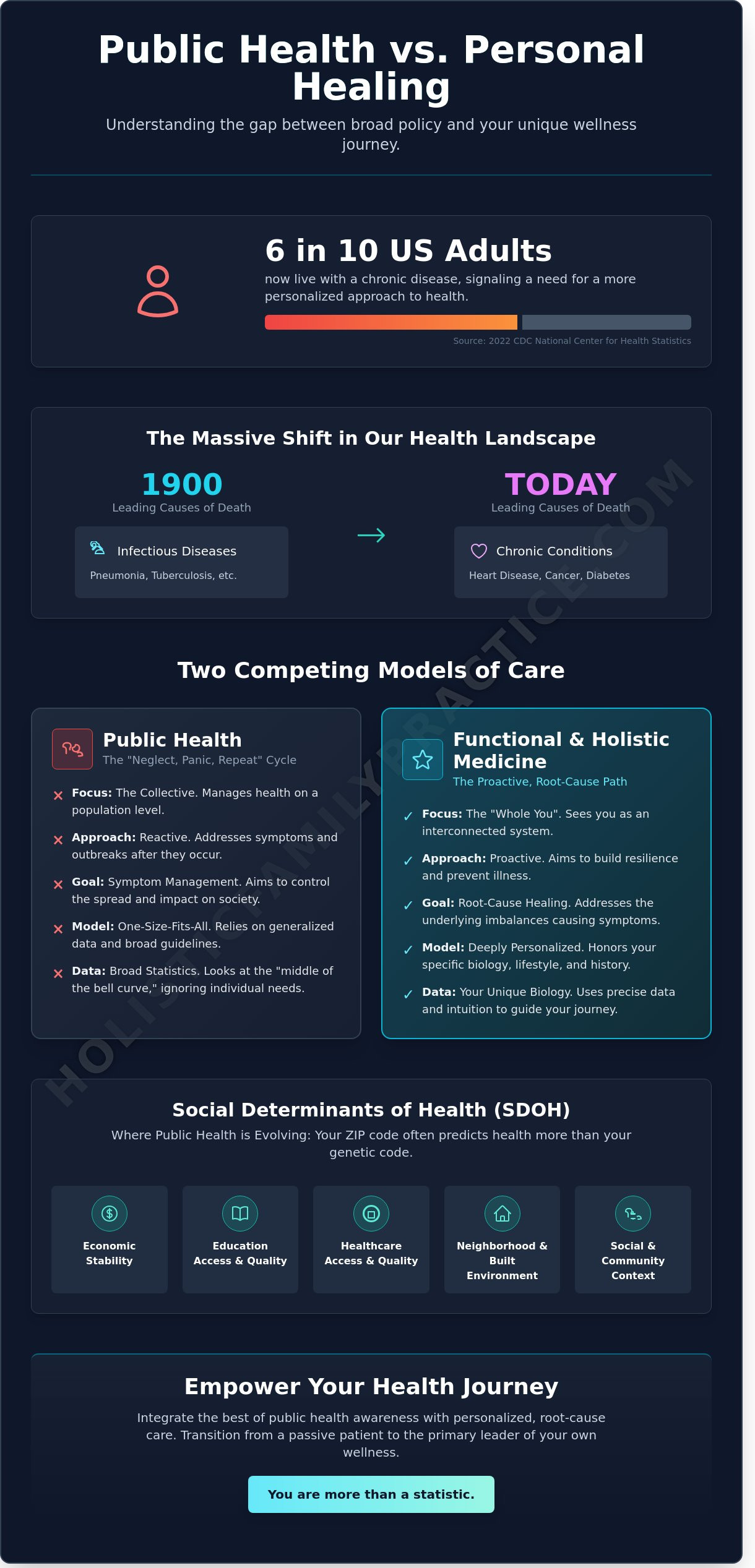
What if the very systems designed to protect our community’s health are actually missing the most vital ingredient for your personal healing? You’ve likely felt like just another number in a massive healthcare machine, frustrated by a “neglect, panic, repeat” cycle that only addresses symptoms after they’ve already disrupted your life. According to the 2022 CDC National Center for Health Statistics report, 6 in 10 adults in the US now live with a chronic disease. This data forces us to ask: are public health efforts holistic enough to address the root causes of our modern wellness crisis? While policy often focuses on the collective, your body requires an intuitive, personalized approach to thrive.
We understand the confusion that comes when government guidelines don’t seem to match your individual health goals. You deserve a partner who sees the whole you, not just a data point on a chart. This guide promises to show you how modern public health is finally evolving toward a more integrated model and how you can bridge the gap between community initiatives and your own root-cause healing. We’ll explore how social environments shape your biology and provide a clear path to integrate public health benefits with the precision of functional medicine.
Key Takeaways
- Understand the evolution of modern medicine and explore the question: are public health efforts holistic enough to support your personal journey toward root-cause healing?
- Learn why your “zip code” often predicts your health outcomes more than your genetics and how to navigate these social determinants of health effectively.
- Compare the reactive “neglect and panic” cycle of mass health policy against the proactive, individualized depth of a functional medicine model.
- Discover how to transition from a passive patient to an empowered health advocate, ensuring you remain the primary leader of your own wellness journey.
- Learn how integrating public health awareness with personalized naturopathic expertise creates a comprehensive path to healing the “Whole You.”
Defining Holism: Are Public Health Efforts Truly Holistic?
Public health traditionally focused on stopping the spread of germs. In 1900, the leading causes of death in the United States were infectious diseases like pneumonia and tuberculosis. Today, we face a completely different reality. Chronic conditions like heart disease, cancer, and diabetes now account for nearly 70% of deaths annually. This massive shift in our health landscape forces us to ask a critical question: are public health efforts holistic enough to meet these modern challenges? True holism looks at the “Whole You,” acknowledging that your daily environment matters as much as your genetic code.
Modern holism isn’t just about alternative therapies. It’s a comprehensive framework that views the human body as an interconnected system rather than a collection of isolated parts. When we evaluate if are public health efforts holistic, we have to look at whether they address the root causes of wellness or simply manage the symptoms of a broken system. While the intentions are evolving, the gap between broad government policy and your personal health journey remains significant.
To better understand this concept, watch this helpful video:
The Evolution of Public Health Perspectives
Public health has come a long way since the sanitation projects of the 1840s. While those early efforts saved millions from cholera, the 21st century requires a focus on mental health and lifestyle choices. The 2020 COVID-19 pandemic acted as a catalyst, highlighting how interconnected our worlds really are. It showed that biological health can’t be separated from social stability or environmental safety. Holistic public health is the integration of social, environmental, and biological factors.
Major organizations like the CDC and WHO are beginning to adopt “Whole Person” frameworks. In its 2022-2027 strategic plan, the CDC emphasizes the importance of social determinants of health. This shift acknowledges that health isn’t just the absence of disease; it’s a state of complete physical, mental, and social well-being. However, there’s a major difference between “Population Holism,” which looks at broad statistics, and “Clinical Holism,” which focuses on your unique biology and soul.
The Gap Between Policy and the Individual
Large scale policies often rely on generalized data to create broad guidelines for millions of people. These “one-size-fits-all” rules frequently fail the individual because nobody is a perfect statistical average. While Public health initiatives provide a necessary safety net for society, they lack the precision required for deep, personal healing. This is where the gap widens. Public health focuses on the middle of the bell curve, often ignoring the unique needs of the individual.
At Holistic Family Practice, we bridge this divide by offering personalized care that honors your specific numbers and emotional landscape. We believe you should start understanding your body better through both data and intuition. Our approach moves beyond broad mandates to help you master your own wellness journey. If you’re ready to move past generic advice and find the root cause of your health concerns, join our New Patient Collective to begin your path toward long-term, wholesome healing.
The Social Determinants of Health: Where Public Health is Succeeding
Public health often feels like a series of clinical mandates, but when we ask are public health efforts holistic, the answer lies in the framework of Social Determinants of Health (SDOH). These five pillars—economic stability, education access, healthcare quality, neighborhood environment, and social context—shape your vitality long before you ever step into a doctor’s office. While medicine focuses on the individual, public health looks at the collective ecosystem. It recognizes that health isn’t just the absence of disease; it’s the presence of resources.
Data consistently shows that your zip code predicts your lifespan more accurately than your genetic code. For example, a 2015 study by Virginia Commonwealth University identified life expectancy gaps of up to 14 years between neighborhoods located only a few miles apart. This disparity isn’t a coincidence. It’s the result of how nutrition, housing, and environmental safety intersect. When we use a holistic approach to public health, we stop blaming individuals for poor outcomes and start addressing the systemic inequities that make wellness a luxury for some and a struggle for others.
Environmental Factors and Your Biology
Your cells are in constant conversation with your surroundings. Poor air quality and water contaminants don’t just cause respiratory issues; they trigger systemic inflammation at a cellular level. In parts of Virginia Beach, we see the impact of “food deserts,” where residents live more than 1 mile from a grocery store but are surrounded by fast-food options. This lack of access directly fuels the obesity and diabetes epidemic. It’s hard to maintain metabolic health when your environment only offers processed calories. We must view local environmental safety as a biological necessity, ensuring every community has clean air and nutrient-dense food options to thrive.
Economic Stability and Mental Wellness
Financial stress is a physiological toxin. Living in a state of economic instability keeps the nervous system in a “fight or flight” mode, leading to chronic cortisol elevation. Over time, this wears down the body, a process researchers call “weathering.” This is particularly evident in minority communities where health disparities are often the result of decades of limited economic opportunity. In our advanced functional medicine consultations, we don’t just look at your lab results. We look at these external stressors. We help you understand how your environment influences your biology, bridging the gap between public policy and personal healing. If you want to start understanding your body better, you can book a discovery call to explore your unique health journey.
Public Health vs. Functional Medicine: A Comparison of Depth
Public health systems often operate in a cycle of neglect, panic, and repeat. We ignore chronic health issues until they reach a crisis point, then rush to apply broad, reactive policies to manage the fallout. While these efforts are vital during emergencies, they rarely address your long-term vitality or personal health goals. When we ask, are public health efforts holistic, the answer usually lies in their objective. They aim for the absence of disease across a population rather than the presence of optimal wellness within the individual.
Functional medicine shifts this focus entirely. It’s a proactive model that views your body as an integrated system, not a collection of isolated parts to be managed by general guidelines. Public health creates the environment through policy and infrastructure, but you control your genetic expression. This is the power of epigenetics. Your DNA isn’t your destiny; it’s a blueprint influenced by your daily choices, thoughts, and environment. If we wonder are public health efforts holistic, we must look at how they prioritize the collective “average” over your specific biological needs.
The Root Cause Difference
Consider how public health treats Type 2 Diabetes. The standard approach focuses on population-wide glycemic control through medication and general dietary “plates.” It’s about symptom suppression on a mass scale. A holistic doctor looks deeper. We investigate the “Whole You,” including gut health, chronic stress, and sleep quality. We don’t just want your A1C under 7.0; we want to restore your body’s natural insulin sensitivity and metabolic flexibility.
Empowerment starts when you “Know Your Numbers.” Moving beyond general guidelines means understanding your unique biomarkers. You can track these through personalized monitoring to see how your body actually responds to your lifestyle. This data transforms you from a passive patient into an active participant in your healing journey. It allows you to address the mind, body, and soul as one unit.
The Bio-Individual Approach
Why do two people living in the same city with the same air quality have different health outcomes? The answer is bio-individuality. Public health relies on “averages” that often overlook the nuances of your specific biology. For instance, many women struggle with hypothyroidism symptoms in females despite having “normal” lab results according to standard reference ranges. General guidelines simply aren’t enough when your hormones are out of balance.
To move beyond these averages, we utilize functional lab testing. These tools identify imbalances before they become diagnosable diseases. By addressing the root cause, we bridge the gap that public health leaves behind. You deserve a health plan that honors your soul and your unique physiological needs. This approach ensures you aren’t just “not sick,” but truly thriving.
Ready to take the next step in your wellness journey? Book a Discovery Call today to start understanding your body better.
Empowering Your Health Journey Beyond Public Guidelines
Public health guidelines provide a necessary safety net, but they aren’t a tailored suit. To truly thrive, you must move from being a passive recipient of care to an active partner in your wellness. This shift is essential because when we ask, are public health efforts holistic, we often find a focus on broad populations that misses the intricate needs of your specific biology. Being your own advocate means bridging the gap between what the government recommends and what your body actually requires.
A fragmented system often leaves you to connect the dots between your nutritionist, your therapist, and your primary care doctor. You’re the only one who lives in your body every day, so you’re the most qualified person to lead your health team. By integrating community resources with private functional care, you create a comprehensive support system that addresses the physical, emotional, and environmental factors affecting your vitality.
Step 1: Understand Your Unique Biochemistry
Standard blood work isn’t always holistic enough. Most routine screenings measure you against a population average where, according to a 2023 study by the University of North Carolina, only 12% of American adults are considered metabolically healthy. This means ‘normal’ isn’t always ‘optimal.’ You should start understanding your body better by requesting comprehensive lab panels. These tests look for hidden imbalances in fasting insulin, inflammatory markers, and nutrient levels before they manifest as chronic disease. Knowing your numbers is the first step toward mastery.
Step 2: Optimize Your Immediate Environment
You can’t always change public policy, but you can control your home. Focus on high-quality hydration and strict sleep hygiene. In a high-stress world, your nervous system needs support to transition into a restorative state. Using glycine amino acid supplements can promote restful sleep and mood stability by acting as a calming neurotransmitter in the brain. Combine this with ‘Rainbow Brain’ techniques to manage sensory overload and practical steps to reduce the toxic load from endocrine-disrupting plastics and synthetic fragrances in your living space.
Empowerment comes from taking consistent, small actions that honor your body’s wisdom. Use this checklist to lead your journey:
- Audit Your Data: Move beyond basic screenings to functional testing that identifies root causes.
- Regulate Your System: Practice daily nervous system reset techniques like grounding or box breathing.
- Curate Your Inputs: Filter your drinking water and air to minimize environmental toxins.
- Personalize Your Nutrition: Eat for your specific metabolic needs rather than following generic dietary pyramids.
- Build Your Village: Connect with providers who see the whole you and respect your intuitive health journey.
Holistic Family Practice: Your Partner in Virginia Beach
While we often ask, are public health efforts holistic, the reality is that large-scale policies often miss the nuances of your individual life. Dr. Erica Steele bridges this gap by combining her deep understanding of public health with her expertise as a naturopathic doctor. She doesn’t just look at statistics; she looks at you. At Holistic Family Practice, our mission is to empower the “Whole You” by addressing the physical, emotional, and environmental factors that dictate your vitality. We believe you shouldn’t just be a passive recipient of care. Instead, you’re a partner in a process designed to uncover the root causes of your health concerns.
When you step into a holistic medical consultation in Virginia Beach, expect a different rhythm than the standard 10-minute clinical visit. An initial deep-dive session often lasts 90 minutes, allowing us to review your “numbers” and your history with clinical precision. We use data-driven insights to create a roadmap for your mastery. This transition from questioning the system to mastering your own health is where true healing begins. You stop reacting to symptoms and start proactive cultivation of wellness.
Personalized Care for a Diverse Community
Our practice specifically serves 5 major patient groups, ranging from families seeking a wholesome foundation to individuals struggling with chronic disease or metabolic imbalances. We know that the modern healthcare landscape is a complex maze. It’s easy to feel lost when 60% of American adults live with at least one chronic condition. Having a wise and nurturing guide makes the difference between temporary fixes and lasting change. If you’re searching for local support, our guide on integrative medicine doctors near me can help you find the accessibility you need. We’re here to ensure that the question of whether are public health efforts holistic doesn’t limit your personal potential for recovery.
Start Your Transformation Today
Your health isn’t a static destination; it’s a dynamic journey that requires consistent input and education. We invite you to take the first step toward self-agency by booking a discovery call or joining one of our upcoming online webinars. These sessions provide the tools you need to understand your body’s intuitive signals and metabolic needs. Don’t wait for a policy change to prioritize your well-being. You have the power to transform your lifestyle through informed choices and soul-centered care. True holistic medicine isn’t just about supplements or diets; it’s an authentic practice that heals the spirit as much as the body.
Ready to move beyond conventional limits? Join the Holistic Lifestyle Community or book your consultation to begin your journey toward total health mastery.
Your Path Toward Integrated Wellness
Public health policies create the essential infrastructure for community safety, yet they often stop at the surface level of population data. When asking are public health efforts holistic, it’s clear that while they address social determinants, they rarely reach the level of individual soul and spirit integration. The World Health Organization notes that social and economic factors drive up to 55% of health outcomes. This leaves a significant gap that you must fill through personal agency and root-cause discovery. You’re more than a statistic in a government report; you’re a complex system requiring a tailored approach that respects your unique biology and history.
True healing happens when you move beyond general guidelines to address the specific needs of your mind, body, and soul. At Holistic Family Practice, Dr. Erica Steele, a board-certified Naturopathic Doctor, helps you navigate this transition from passive recipient to active health advocate. By focusing on functional medicine and long-term lifestyle mastery, you can uncover the underlying imbalances that standard policy often misses. It’s time to stop settling for “fine” and start pursuing a state of vibrant, whole-person vitality. Your journey toward lasting wellness begins with a single step toward self-responsibility.
Empower your health journey. Book your Holistic Consultation with Dr. Steele today.
Frequently Asked Questions
What is the definition of a holistic approach in public health?
A holistic approach in public health means addressing the interconnected factors that influence a community’s well-being, rather than focusing solely on disease prevention. When we ask are public health efforts holistic, we’re looking at the biological, psychological, and social dimensions of health. Instead of just treating a symptom, this framework seeks the root cause within the environment. The World Health Organization defined health in 1948 as a state of complete physical, mental, and social well-being.
How do social determinants of health relate to holistic medicine?
Social determinants of health are the external conditions that mirror the internal root-cause philosophy of holistic medicine. While a holistic practitioner looks at your gut health or stress levels, public health looks at your zip code. According to University of Wisconsin data, these social factors account for 80 percent of your health outcomes. By improving access to clean water and nutrient-dense food, policy makers address the foundational layers of the Therapeutic Order at a population level.
Can public health efforts be truly holistic if they are not personalized?
Public health efforts often struggle to be fully comprehensive because they prioritize population-wide data over individual biochemical uniqueness. To understand if are public health efforts holistic, we must look at how they bridge the gap between population data and your personal needs. While policy can create a healthy environment, your personal health journey requires a customized approach to nutrition. You can see this gap in generic dietary guidelines that don’t account for the 10 percent of Americans with specific metabolic sensitivities.
What is the difference between public health and functional medicine?
The primary difference lies in the scale of intervention; public health focuses on the collective community while functional medicine centers on the individual’s unique biological systems. Public health uses tools like vaccination rates or air quality standards to protect the masses.
Functional medicine uses diagnostic testing to identify the root cause of your specific symptoms. Both aim for wellness, but functional medicine empowers you to master your own internal environment through personalized protocols and data tracking.
Are there holistic public health initiatives in Virginia Beach?
Virginia Beach supports several holistic initiatives, such as the 757 Farmers Market and the city’s commitment to maintaining over 200 parks and 4,000 acres of open space. These resources encourage movement and access to whole foods, which are essential for nervous system regulation. The Virginia Beach Department of Public Health also offers programs like WIC, which provided nutritional support to over 10,000 residents in 2023. These efforts help build a foundation for long-term community wellness.
How can I take a holistic approach to my own health if the system is not?
You can take a holistic approach by becoming the primary investigator of your own health and focusing on factors within your control. Start by tracking your own data, such as your daily hydration or sleep quality, to understand your body’s unique rhythms.
Focus on the Therapeutic Order by prioritizing foundational needs like whole-food nutrition and stress management. When you Know Your Numbers and understand your metabolic health, you gain the power to thrive regardless of external policy limitations.
Why is intersectionality important in holistic public health?
Intersectionality is vital because it acknowledges that overlapping social identities create unique health experiences and barriers. A 2022 study in the American Journal of Public Health showed that health outcomes differ significantly when these factors converge. A truly holistic perspective must respect these diverse backgrounds to decolonize healthcare. Without this understanding, public health efforts remain one-dimensional and fail to reach the most vulnerable members of our community. This approach ensures that every individual’s soul is seen and valued.
What role does mental health play in holistic public health efforts?
Mental health is the cornerstone of holistic public health because the mind and body are inseparable systems. When you address community stress or trauma, you’re also addressing physical markers like inflammation and cortisol levels. Approximately 1 in 5 adults in the U.S. lives with a mental illness, making it essential to integrate emotional support into every health policy. By fostering mental resilience, we empower individuals to stay engaged in their physical healing journeys and overall wellness.
Take the next step in your wellness journey by joining our Holistic Lifestyle Community or enrolling in our holistic health courses. If you’re ready for a personalized approach, book a consultation or explore the Holistic Life App to start understanding your body better today.

Article by
Dr Steele, Holistic Doctor
Dr. Erica Steele, DNM, ND, CFMP, BCND, MPH, MBA, is a holistic doctor, public health educator, and founder of Holistic Family Practice and the Integrative Health Sciences Institute.
With over 15 years of experience, Dr. Steele specializes in root-cause healing, functional lab analysis, and holistic health education. Her work focuses on bridging clinical data with lifestyle transformation, empowering individuals to take control of their health through informed, sustainable practices.
She is also the creator of the Holistic Life App and leads a global community dedicated to holistic living, nervous system regulation, metabolic health, and decolonizing healthcare.
Dr. Steele is passionate about advancing holistic medicine through structured education, research, and community-based healing models.
Disclaimer
This content is for educational and informational purposes only and is not intended as medical advice, diagnosis, or treatment. Always consult with a qualified healthcare provider before making changes to your health regimen.
Holistic Family Practice does not provide emergency medical services, hospital care, or insurance-based treatment. Participation in any program, consultation, or educational content is voluntary and intended to support general wellness and health literacy.